
Investment Strategy
The benefits of a globally integrated fixed income process - Angles & Perspectives Q1 2023

In the second article, Assistant Fund Manager Ané Craig and Head of Fixed Income Lyle Sankar explore our globally integrated approach to fixed income investments. Looking at investment opportunities through a global lens improves our understanding of the potential range of outcomes, both negative (the left tail) and positive (the right tail). There seems to be significant complacency in local fixed income markets, which presents an opportunity to enhance risk-adjusted returns and add to portfolio diversification through a global approach.
While we have previously explained how our globally integrated process works for our equity and multi-asset portfolios, this article explores our approach to fixed income investments. Looking at investment opportunities through a global lens improves our understanding of the potential range of outcomes, both negative (the left tail) and positive (the right tail). While we believe South African banks are generally well capitalised and managed, there appears to be complacency in the local fixed income markets, which presents an opportunity to enhance risk-adjusted returns and add to portfolio diversification through a global approach.
The fixed income investment landscape has changed
For almost 15 years, local fixed income investors have had few reasons to look offshore to developed markets for yield given the attractive real yields available locally, narrowing the universe of attractive investment opportunities. However, with the return of persistent inflation and repricing of financial assets, we believe it is more important today to consistently compare global and local opportunities to ensure that clients are exposed to the best potential outcomes.
Recent events in the market have seen several US banks (Signature Bank and Silicon Valley Bank (SVB), amongst others) and one major global systematically important bank (Credit Suisse) become distressed due to the impact of rising interest rates (and higher bond yields). It is easy to view these events as only likely to impact the rand/US dollar or overall market risk sentiment. However, the distress in global banks also highlighted complacency in local fixed income markets (and therefore risk of a fall in prices) and provided the opportunity to vastly improve risk-adjusted returns by evaluating assets on a globally integrated basis.
How did we get here?
In March 2022, the US Federal Reserve (the Fed) finally conceded that inflation was not transient and had to be reined in. Having delayed hiking interest rates, waiting for inflation to subside, the Fed subsequently proceeded to hike rates steeply. Banks, businesses and consumers alike had to come to terms with the impact of rapidly rising interest rates.
Higher interest rates affect banks on both sides of the balance sheet. From an asset perspective, it puts pressure on the loan book, as borrowers face a higher debt burden, which puts pressure on credit quality. When the starting point is multi-year low government bond yields, higher interest rates also cause banks to suffer losses on their investment portfolios through higher government bond yields. From a liability (deposit) perspective, rising interest rates can lead to deposit outflows (affecting smaller banks the most) while also causing some investors to switch to money market funds, which offer higher interest rates. In 2023, the combined effect of these drivers caused a liquidity squeeze for some smaller US banks, and forced SVB to sell longer-dated bonds at a loss. SVB investors rushed to withdraw their funds (the bank had many depositors with exposures in excess of the Federal Deposit Insurance Corporation’s
US$ 250 000 insurance limit), and an old-fashioned bank run quickly ensued.
Unfortunately, what started as a specific problem at some regional banks in the US, soon caused jitters in other areas too, including on the other side of the Atlantic.
Contagion at Credit Suisse had major repercussions for fixed income markets
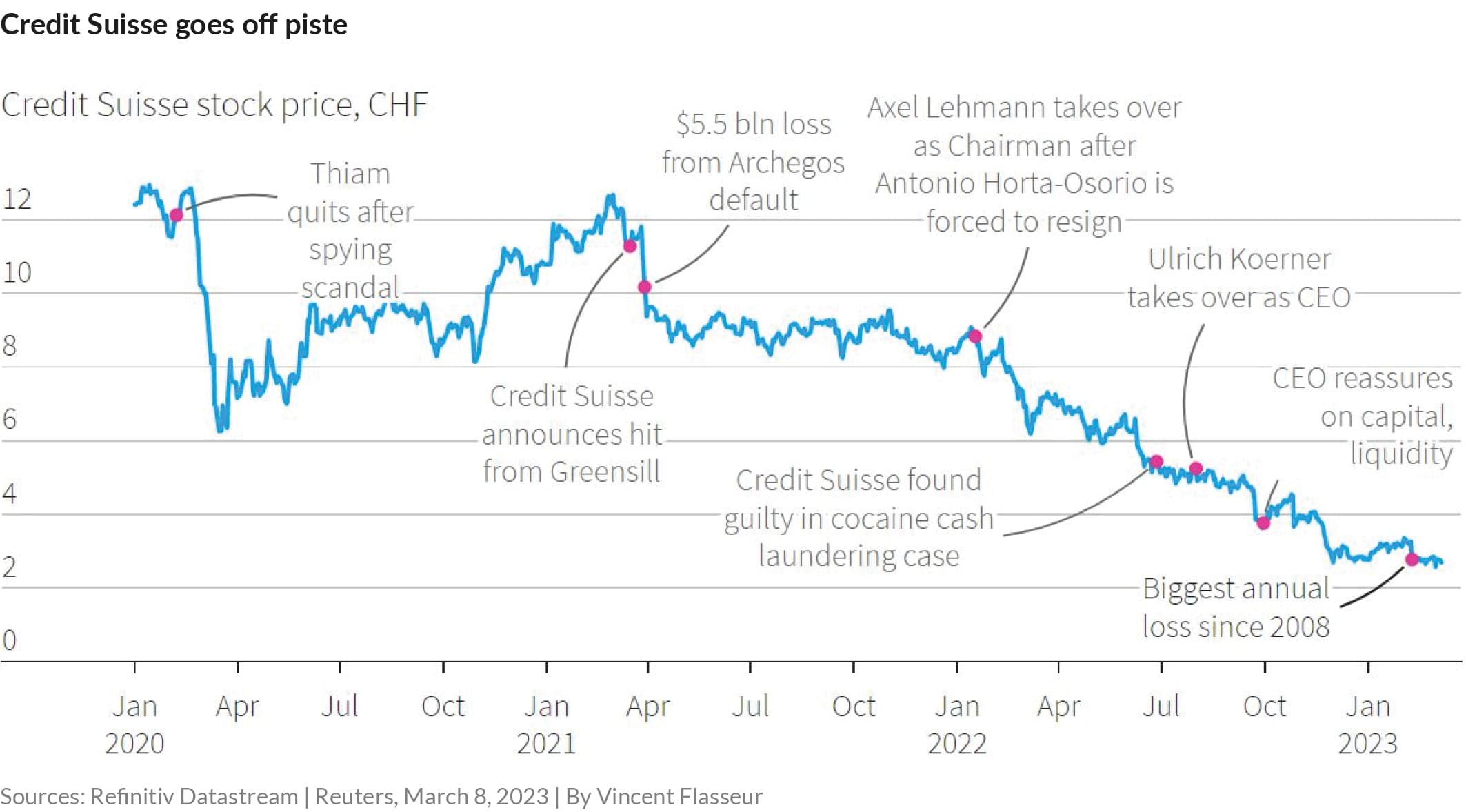
Credit Suisse (CS) had experienced a slow decline for some time already, having suffered both from poor profitability in its investment bank in the past, and having been tainted by scandal that tarnished its reputation. While reasons for the bank’s failure will become clear over time, it seems likely that it was a liquidity crisis that ultimately led to regulatory intervention and the sale of CS to UBS.
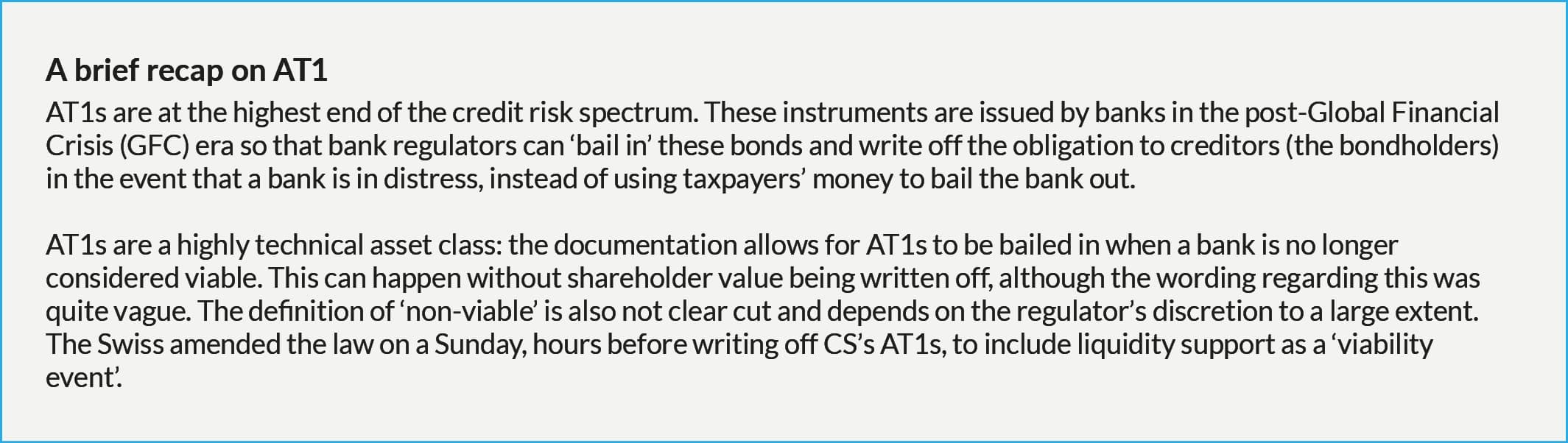
In an effort to contain further fallout, Swiss regulators brokered a controversial weekend deal with CS being sold to rival UBS for US$3 billion. As part of the hasty restructure, CS additional tier 1 securities (AT1s) were bailed in, but equity (value to shareholders) was not written off. This had repercussions for credit markets, as investors had understood equity to be junior to AT1, i.e. questions were raised about whether regulators respected bond investor rights and the creditor hierarchy. We previously wrote about AT1 instruments and their unique risk characteristics in our Q3 2022 Angles & Perspectives, in The safer bet amongst South African fixed income assets.
Naturally, these developments raised some questions for AT1 investors:
Has the risk of a write-off for these instruments been heightened?
Will banks buy these instruments back at their call dates, as the market always expected, or are these now perpetual instruments?
Should these ‘bonds’ be priced like equity, given that they were riskier than equity in the case of CS?
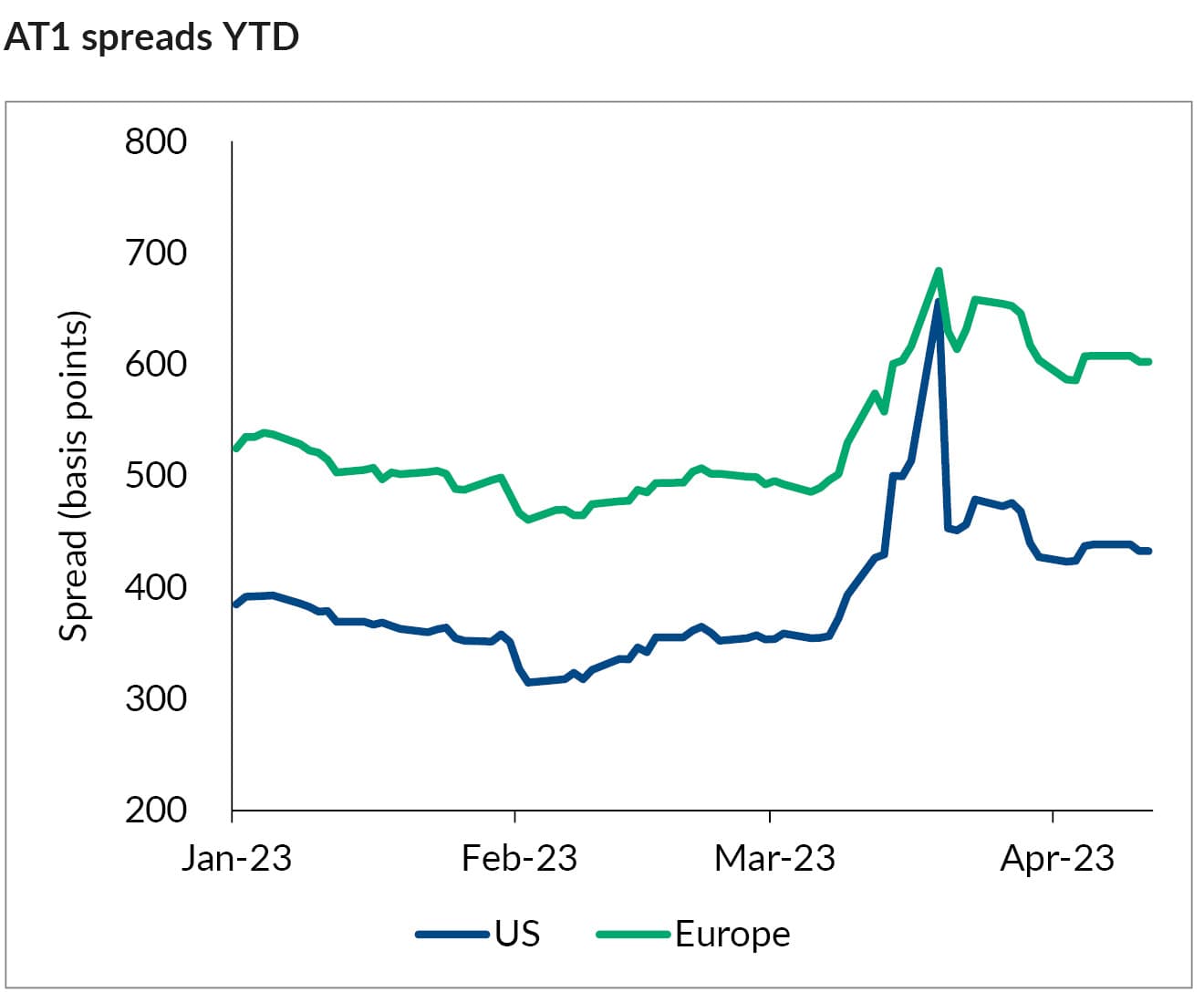
Consequently, AT1s sold off globally.
A 3M understanding of the risks of investing in banks
At PSG, we apply our 3M investment philosophy and process to all investment opportunities, locally and globally. In assessing banks, we apply a similar framework when buying shares and bonds in banks, as these are highly geared entities with unique risk considerations.
Firstly, we assess the moat of the bank. Do they have sustainable market share, a stable deposit base and appropriately diversified income streams? We pay particular attention to management teams, looking at prudent risk management, transparency, track record of returns on equity and assets and credit losses. Finally, we focus on margin of safety, ensuring the banks we invest in are providing sufficiently for expected credit losses, are diversified sufficiently and have enough capital and liquidity. Finally, running a globally integrated process, we are also able to consider the opportunities available to fixed income investors on a holistic basis, and ensure that investors achieve the best risk-adjusted returns.
We believe this globally integrated investment process sets us apart from many competitors, and contributed to the success of our fixed income funds: the PSG Diversified Income Fund and PSG Income Fund both earned accolades at the recent Raging Bull Awards*. |
Ultimately, a robust and proven philosophy that truly considers the bigger picture, enables us to deliver sustained investment performance to our clients, helping them to achieve their investment objectives in the long run.
*Details of the award can be obtained from PSG Collective Investments (RF) Limited.
Share