
Investment Strategy
Is quality investing a trap? - Angles & Perspectives Q1 2026

One of the most intuitively appealing ideas in investment management is a focus on buying quality shares. And yet, this approach has not rewarded global investors over the past four years. The question is why. We believe this is because the methodology does not include a price overlay, like other factor approaches that autocorrect to take price movements into account. This leaves investors exposed to lengthy periods of underperformance – even though they hold quality companies that should, on the face of it, make for great investments.
What is quality investing?
In quality investing, the focus is on buying and holding the shares of exceptional businesses for the long term. Quality companies have high returns on capital, defendable franchises, recurring earnings growth, and strong balance sheets. So, buying and investing in these companies seems like an easy recipe to follow, and one which should surely guarantee success. Yet, quality investing has had a difficult few years. A closer look at the mechanics underpinning this approach provides some clues as to why this is the case.
Factors in investing: what are they, and why do fund selectors use them?
Eugene Fama and Kenneth French were able to explain up to 95% of a diversified stock portfolio’s returns by focusing on a broad classification of types of shares and their overall contribution to performance. They originally focused on three factors – i.e. size, value and excess market return – but subsequent research and analysis have seen several variants emerge. Thus, market participants are now able to analyse several ‘factors’ that explain the bulk of equity returns and risk over time. Today, portfolio constructors generally favour five factors – i.e. quality, value, momentum, growth and size – to fine-tune portfolio construction, target preferred outcomes, and ensure risks remain within parameters tolerable to clients.
Index construction matters
For many investors, the factor investing journey starts by looking at the constituents of different indices, so understanding the nuances of how these indices are constructed matters, and it impacts the outcomes that are achieved.
Quality indices include shares that meet specified financial criteria, including return on equity, earnings variability and good debt-to-equity ratios. However, they do not take into account share price or valuation. In contrast, value indices are self-correcting. As stocks become expensive, their weight diminishes and cheaper names rotate in. Momentum indices rebalance by definition, selling what has stopped working. However, quality indices do neither. A quality business that doubles in valuation remains in the index at twice the weight. There is no automatic mean-reversion mechanism, no discipline that forces a price check. The result is that quality indices can, and do, accumulate enormous valuation premiums with no corrective signal, and this represents a crucial vulnerability to quality investing. |
The data bears this out. The relative price-to-book ratio of the MSCI World Quality Index versus the broad market peaked at 3.2x in May 2020 before compressing to 2.3x today. The relative enterprise value (EV)/sales premium built steadily from 2013 and reached a peak in 2023, before retreating. Perhaps most strikingly, quality stocks entered 2013 trading at virtually the same forward P/E as the broader market. Quality was in effect available for free, before commanding a near -30% earnings premium at the 2024 peak. This outcome is unavoidable when no valuation overlay is taken into account and markets are running hot in a world of extraordinary monetary accommodation.
Quality businesses benefited in the low interest rate environment
Quality businesses are long-duration assets. Their value is heavily concentrated in distant future cash flows, which makes them acutely sensitive to the discount rate applied to those flows. A decade of near-zero real interest rates was not merely a benign backdrop for quality investing – it was the primary driver of its outperformance.
The earnings yield of the MSCI World Quality Index minus the US 10-year TIPS yield tells the story precisely. Through the zero interest rate policy (ZIRP) era, quality offered investors nearly 4 percentage points of earnings yield above the real risk-free rate on average – a compelling compensation for equity risk. At the April 2020 trough, that spread reached almost 6%. It was rational for investors to pay up. By June 2024, that same spread had compressed to 1.4%, a level that only made sense if real rates were going to zero and staying there. They did not. Today the spread sits at 2.0%, still 170 basis points below its long-run average. The valuation derating is not complete.
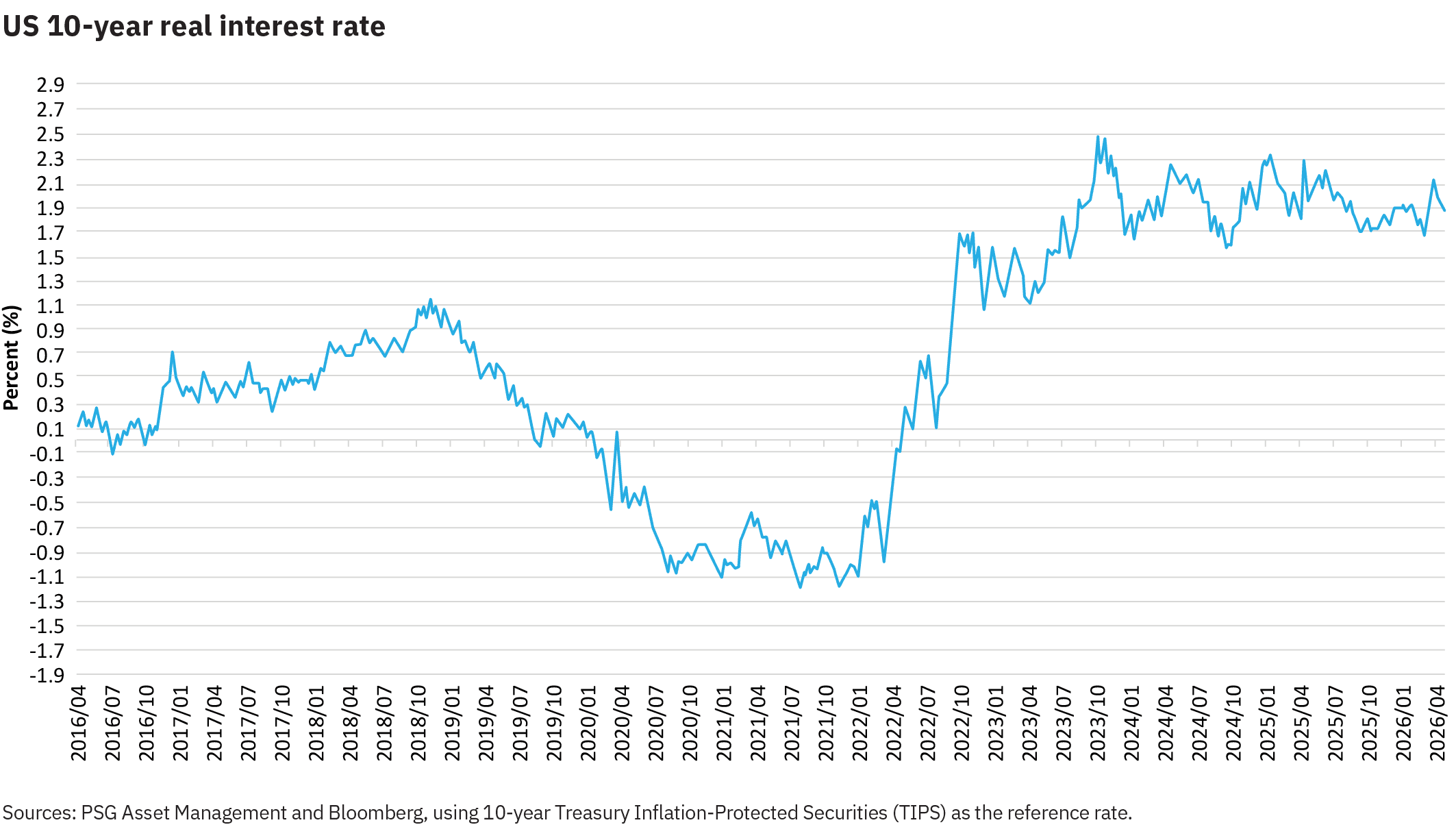
The dividend yield picture is equally stark. Quality stocks now offer a dividend yield below the real risk-free rate: a spread of -0.4% versus a long-run average of +1.1%. The income logic that underpinned a generation of quality investing has structurally reversed. Risk-free real rates of 2% change the calculus for every long-duration asset, and quality equities are among the longest duration instruments in public markets.
Active management has not achieved better outcomes
Active management did not compensate for the weaknesses in index construction either. We examined a selection of well-known quality managers with Section 65 approved funds available to South African investors. Over the 10 years to March 2026, the MSCI World Quality Index outperformed the broad MSCI World Index, returning 13.4% p.a. versus 11.8% p.a. Yet, across our sample of active quality managers, every single fund underperformed the broad market over the same period, with relative returns ranging from -22% to -33% against the MSCI World Index.
The picture since the rate cycle turned in 2022 is more severe. The quality index itself underperformed the broad market over this period, returning 7.7% p.a. versus 8.3% p.a. (from 31 December 2021 to 31 March 2026). Active quality managers fared worse, with total returns ranging from negative territory to low single digits over four years in which the MSCI World Index delivered over 40%.
What this means for South African investors
South African fund allocators have a well-documented
concentration problem in offshore equity. The typical multi-manager or discretionary portfolio assembled over the past decade reflects a period in which quality was the dominant performance narrative. The result is that many SA investors hold multiple quality managers who, despite different names and marketing materials, own substantially overlapping portfolios of the same 30 to 50 global businesses, priced (until recently) for a world of permanent zero real rates.
This is not a case against quality as an investment philosophy. Quality businesses remain exceptional capital allocators over full cycles, and the valuation derating of recent years has made the entry point meaningfully more attractive than it was in 2021. The relative forward P/E of the quality index has now reverted to its long-run median. However, over shorter periods, quality indices are vulnerable to losing sight of the fact that the starting price at which an asset is acquired is one of the key determinants of the long-term outcomes the investors achieve.
Investors need to be vigilant against a concentration of style exposure. Blending valuation-sensitive managers, those who treat price as an input rather than an afterthought, with managers who are genuinely unconstrained by factor purity, would have materially reduced the damage of the past four years. This would also position a portfolio to participate in the recovery should the quality factor mean-revert, while maintaining exposure to managers who can generate returns in a wider range of market environments.
When pursuing quality investments, manager style diversification matters, because the quality of a business and the quality of an investment are not the same thing. Starting valuations have always mattered. The past four years have simply made that lesson unusually expensive.
Share