
Investment Strategy
Revisiting the ‘big unwind’ and how to build future-fit portfolios

Four years ago, we wrote that global financial markets had become very distorted over the prior decade (Capitalising on the ‘big unwind’ – picking stocks that are fit for the future). We anticipated an unwinding of these distortions – a process that we anticipated would take several years and have a material impact on asset prices. At the time, we warned that assets which had benefited from these distortions were likely to disappoint – relative to expectations – in the big unwind. And we argued that building a portfolio that was fit for the future required differentiated global asset allocation and stock selection.
The original article, written in 2022, mentioned five factors that had had a dramatic impact on asset prices. Those were:
Very cheap money – the extremely low cost of capital and negative real rates in the developed world that had supported high prices of financial assets.
The rise of passive investing – a fundamental reallocation of funds towards the winners of the past at the expense of the losers. Notably, most portfolios had materially drifted closer to benchmark indices, upweighting winning funds and stocks at the expense of poorer performers.
The ESG movement – although we are supportive of sustainable initiatives, we noted that capital has been redirected away from perceived ‘bad’ industries to ‘good’ industries, in most cases with limited consideration of the unintended consequences.
Capital flight from South Africa – both foreigners and locals had drastically reduced exposure to domestic assets, in favour of some of the beneficiaries of global market conditions.
Fiscal stimulus – had started to ramp up, initially in the form of tax cuts, but subsequently via vast cash payments to counter the impact of the pandemic. The injections primarily funded private consumption and savings, rather than expanding productive capacity.
Four years later, this is an opportune time to revisit those distortions, consider what has happened over the last four years, and assess where we stand today.
The era of cheap money has come to an end
Since we first shared our views, G7 bonds have entered a bear market and the valuations of long-duration quality stocks have been eroded. Arguably, the era of cheap money has come to an end.
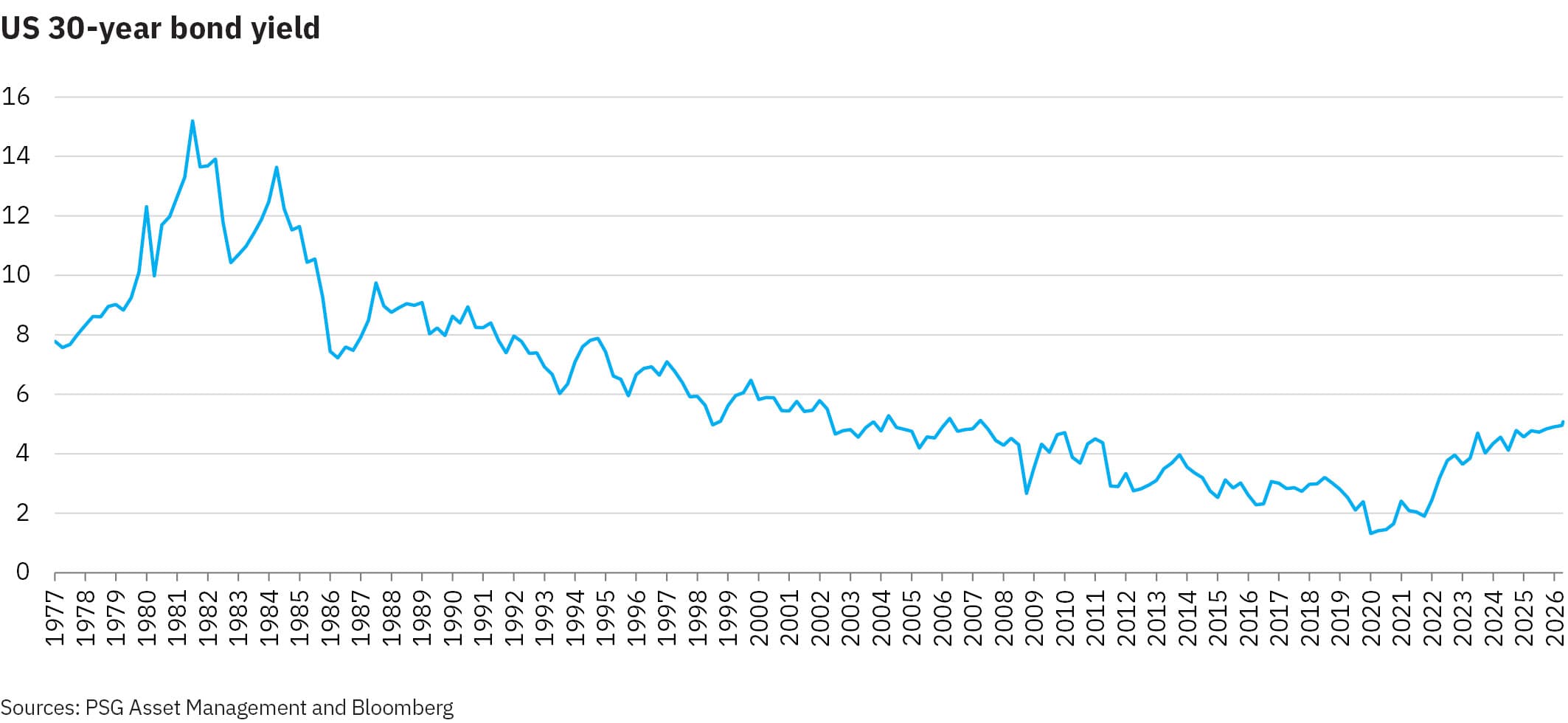
Global yields crashed during the pandemic of 2020 to exceptionally low levels – at the end of 2020, we had 18 trillion US dollars’ worth of negative-yielding bonds in nominal terms. Moreover, the low yields of 2020 came after four decades of declining bond yields (a structural bull market in bonds). Market participants were clearly complacent, assuming that inflation was a thing of the past. By 2022, rate normalisation was underway and the cost of capital was rising. However, the US 30-year bond still had negative real yields. Subsequently, we have seen very poor performance by bonds (negative capital returns since 2022 and negative returns in three of the past five years for US Treasuries), following the return of inflation, remaining stubbornly above the US Federal Reserve’s 2% target since March 2021.
Since we first shared our views, G7 bonds have entered a bear market and the valuations of long-duration quality stocks have been eroded. Arguably, the era of cheap money has come to an end.
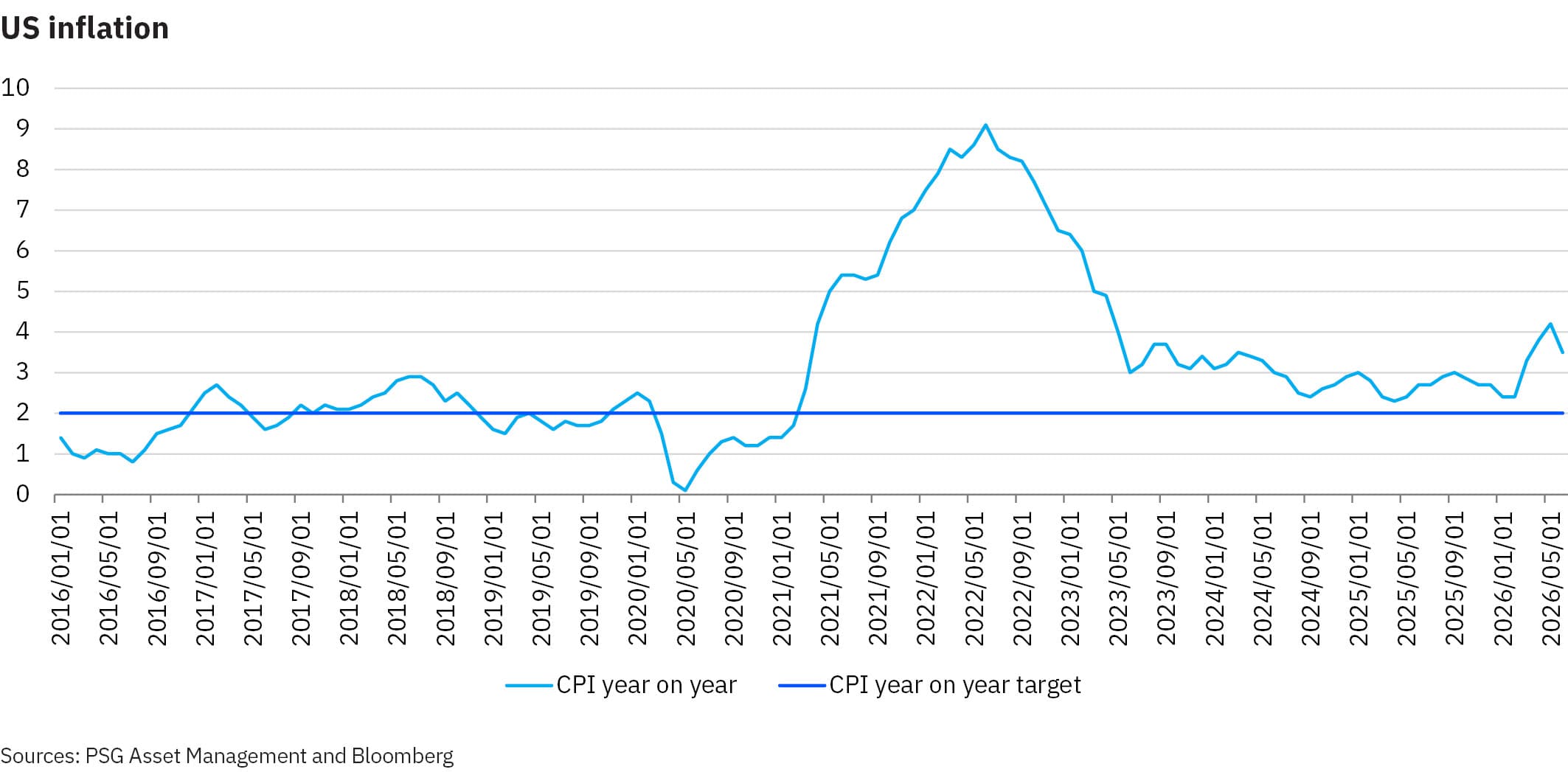
The new structural bear market in global bonds has seen an unwinding of the efficacy and popularity of the 60:40 portfolio, with bonds and equities becoming positively correlated amidst lax fiscal policy and high government debt levels.
Over the past four years, we have also witnessed the unwinding of the exuberance around quality stocks and an underperformance of quality mandates. Owners of long-duration quality compounders have discovered that valuations were dependent on the ultra-cheap cost of capital. It should come as no surprise that the relative performance of quality investing as a style peaked around the low point in bond yields.
Peak distortions caused by ESG investing have unwound over the past five years
An investment in Exxon Mobil has compounded at more than 25% per annum since the beginning of 2021, while Vestas (the dominant player in wind energy) has lost 10% per annum over the same period. To be clear, sustainable investing is very important, and we hope that it is ultimately implemented globally in a pragmatic way that balances sustainability goals and investment outcomes. However, when implementation is unbalanced (as it was in 2021/2022), distortions arise that create opportunity and risk.
Sustained high levels of fiscal stimulus have become a dominant feature of the global economy over the past decade
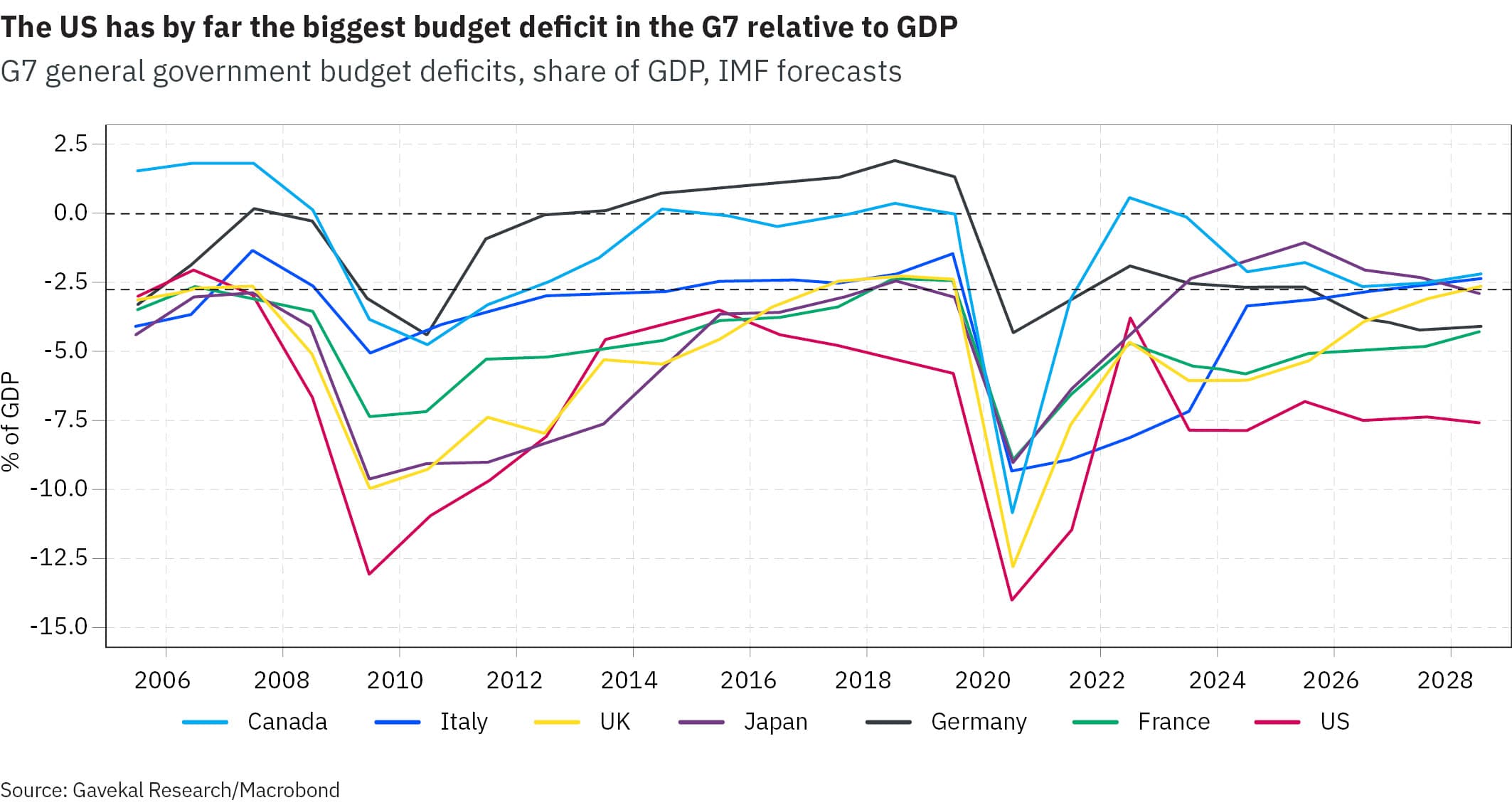
The US is leading in this regard. As the chart below shows, the US has become comfortable to continue running budget deficits of between 6% and 8% during times of robust economic growth and low levels of unemployment. The political incentives constrain any attempt to rein this in, so it is up to the bond market to provide the constraint. Given our base case that global inflation is more likely to be higher than target in this economic climate, we anticipate higher than expected interest rates to impact asset prices in the future. While we would continue to generally be cautious of longer-dated G7 bonds and expensive long-duration stocks, as bond yields have started rising, for the first time in several years we are seeing positive real yields in developed market bonds, and have started adding these selectively to our portfolios as appropriate. Similarly, several former market darlings (perceived global quality stocks) have seen dramatic share price declines, and our process is starting to identify a number of attractive opportunities.
Passive continues to dominate, and adds to the potential for a painful unwind
The trend towards passive investing has continued in global markets and is now much bigger than active in US equities. We agree that passive plays a vital role in constructing low-cost diversified long-run portfolios. However, we continue to highlight the distortions that arise in late-cycle equity bull markets when money is allocated in a price-insensitive fashion to recent winners. This, when combined with the current artificial intelligence (AI) exuberance, results in very concentrated indices and inflated prices for mega caps. With the US trading on very extended valuations and equity allocations (or risk appetite) around all-time highs, this market remains very vulnerable to a reversal of passive inflows.
The AI theme has become the dominant component of equity indices and returns in the US (and other tech-heavy markets) with the AI capex cycle driving the majority of earnings growth. Given the revolutionary nature of this technology and the explosive rate of change in adoption, it is not wise to claim any precision on the medium- to longer-term impact on financial markets. That said, US and other tech-heavy indices require sustained intensity in the capex cycle to justify current valuations and it is far from clear that returns on investment will be high enough to justify the scale of investment. Unsurprisingly, the concentrated nature of global markets provides long-term stock pickers like PSG Asset Management with excellent opportunities outside of the much-loved and dominant components of global indices.
An end to the dollar bull market may have material consequences for markets
The US dollar has shrugged off the headwind of sizeable twin deficits to sustain a 15-year bull run since 2011. It is too soon to say whether the dollar has peaked but it is worth pointing out that to maintain its value requires the continued willingness of foreign investors to buy US assets. This requires the AI trade to remain robust. It also requires a lack of incentive for foreign investors to retain capital and invest domestically. Given the need for domestic capital to keep bond yields contained and to fund domestic industrial, infrastructure, defence and technology requirements, it is highly likely that creditor nations like Japan will be incentivised to invest less capital offshore in the future, or even bring capital home. This is particularly relevant given the antagonistic stance the US is taking to former allies. A weaker dollar tends to coincide with strong commodity and emerging market performance. We foresee long-term outperformance by emerging markets and starting valuations are very attractive.
Capital has stopped fleeing SA, but we are still waiting for equity inflows
SA bonds have enjoyed a generational bull market over the past two years, with yields on the 10-year bond dropping from around 12% to below 9% (also read SA Inc. – All that glitters is not gold). This has seen strong support of the local bond market by foreigners. Unfortunately, this has yet to translate into meaningful inflows into the SA Inc. part of the equity market, though precious metals attracted decent demand last year and early in 2026. Domestic confidence remains low, GDP growth anaemic and the Iran war has dampened risk appetite. However, all the ingredients are in place for a positive environment for equity inflows at some stage in the future. These include a sustained commodity and EM cycle, prudent local fiscal and monetary policy, continuation of domestic reforms and ongoing political stability.
The ‘big unwind’ remains in motion
It seems clear that many of the distortions mentioned at the start of this article are in the process of unwinding. Others are likely to unwind in the future. This will have a material impact on asset returns.
Accordingly, we continue to advocate for a portfolio that is future-fit. To us, this involves avoiding securities that have benefited from distortions and are susceptible to an unwind, and investing in neglected areas that are beneficiaries of a changing investment regime. Our portfolios reflect our belief that some of the ingredients of the winning portfolio of the future likely include:
Global value stocks, offering attractive margins of safety with a bias for high free cash flow yielders, diversified across industries and geographies.
Real assets, beneficiaries of constrained supply-side economics and offering inflation protection.
Emerging market equities and bonds, well diversified to manage country-specific political risk.
Cash, a forgotten asset class that provides liquidity to buy into the inevitable fear that grips markets from time to time.
Portfolio hedges like derivatives, gold and energy.
Share