
Investment Strategy
Why now? The case for a global fixed income fund in the current environment

Over the past 15 years, global investors faced an uncomfortable reality in which bonds did not offer compelling returns or consistent portfolio protection. Fixed income assets did perform their role as safe-haven assets during periods of acute crisis in the post-Global Financial Crisis (GFC) environment – like the European sovereign debt crisis of 2011 and the Covid-19 shock of 2020. However, these bursts of safe-haven demand masked an underlying reality of deeply negative real yields and structurally poor long-run return prospects for buy-and-hold investors. As such, fixed income was increasingly viewed as an insurance asset: valued not for what it earned, but for how it behaved during periods of equity market stress. However, more recently, the post-GFC world has changed materially, and this change underpins our decision to launch the PSG Global Diversified Income Fund now.
The return of real yields
The most fundamental shift in global fixed income markets over the past three years has been the restoration of positive real yields. For over a decade following the GFC, the combination of quantitative easing, suppressed policy rates, and structurally weak demand pushed real rates across the curve into negative territory. Investors in US Treasuries, German Bunds and UK gilts were, in real terms, paying governments for the privilege of lending to them. This was not an environment in which fixed income deserved a strategic allocation within portfolios on the basis of its own return profile.
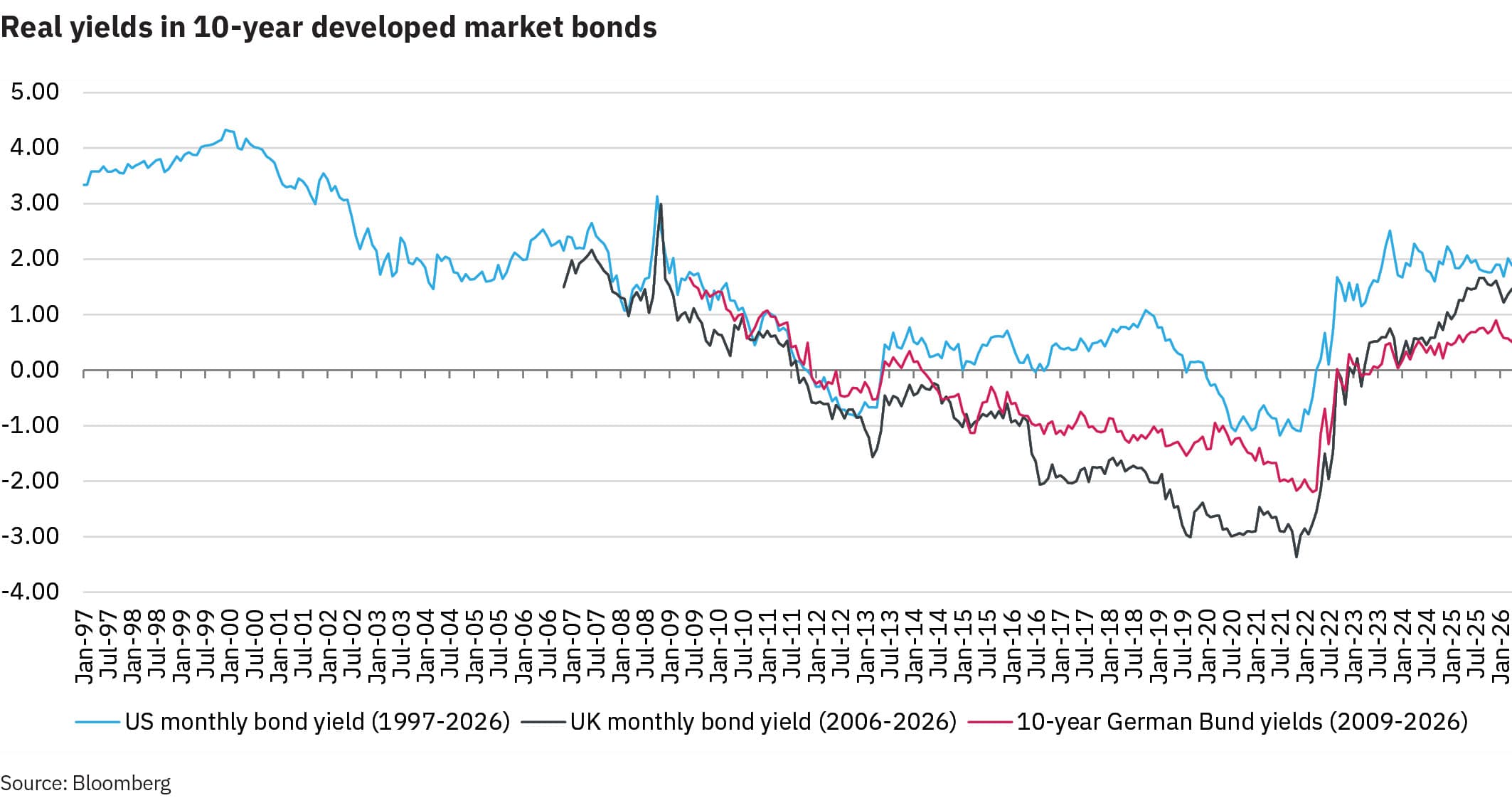
The most fundamental shift in global fixed income markets over the past three years has been the restoration of positive real yields.
That has changed. Real yields on high-quality fixed income are now comfortably positive across the curve. A flexibly managed income fund – able to move across maturities and instrument types as the opportunity set evolves – can access a broad range of instruments offering real returns that are not just acceptable but also competitive with long-term historical averages. When we evaluate instruments against a benchmark anchored to the US Secured Overnight Financing Rate (SOFR) plus a spread, we find genuine value available without having to take on imprudent credit risk. In short, fixed income has again become an asset that can be held on its own merits.
What changed the macro regime
To understand why the opportunity is real and not temporary, it is worth revisiting why real rates were so compressed for so long. The post-GFC world was characterised by a chronic excess of savings over investment – what economists loosely labelled a ‘savings glut’. Demand was structurally weak across the developed world, ageing demographics compressed consumption, and the private sector deleveraged persistently in the aftermath of the credit crisis. Into this environment, central banks deployed successive rounds of quantitative easing, suppressing yields at every point on the curve and crowding investors out of safe assets into riskier alternatives. The ‘TINA’ environment – There Is No Alternative to equities – was not born of equity strength alone, but also of fixed income weakness.
Several of those structural forces have materially shifted. Fiscal policy has become substantially more expansionary in most major economies, reversing the austerity that had restrained demand in the post-GFC period. Deglobalisation and the re-onshoring of supply chains are structurally inflationary compared to the hyper-globalised world that preceded them. Demographics in key economies are no longer a source of savings surplus. And the energy transition, whatever its long-run effects, introduces ongoing cost pressures that central banks cannot fully offset through demand management. The world is simply less disinflationary than it was, and that has changed the equilibrium level of both nominal and real rates.
The equity risk premium has compressed
This shift in the interest rate environment has a direct implication for how one should think about asset allocation. For much of the past decade, equities held a near monopoly on the ability to generate real returns. Fixed income, with negative real yields, was held as tail-risk insurance – accepted as a drag on returns in exchange for portfolio protection. Investors rationally extended duration in equity-like credit, compressed spreads, and accepted structures that would have been unacceptable in a normal rate environment, all in search of income.
That dynamic has now changed meaningfully. The equity risk premium – the excess return investors demand to hold equities over the risk-free rate – has compressed to levels that reflect a market still largely calibrated to a low-rate world. At the same time, fixed income at current real yields can be defended on its own investment merits, not just as a portfolio diversifier. This creates a more balanced landscape for capital allocation, and one in which a well-constructed income fund has genuine appeal for investors who previously had little reason to look beyond equities.
A conducive environment for tactical allocation
Beyond the buy-and-hold case, we believe the current environment is particularly well suited to active management within fixed income. The global economy is in the process of finding a new equilibrium – a new neutral interest rate (r*) that is consistent with more expansionary fiscal policy, less deflationary supply dynamics, and a more constrained central bank reaction function than markets grew accustomed to during the quantitative easing (QE) era. The process of finding equilibrium is rarely smooth.
Markets are prone to extrapolating recent trauma. The bond losses that began in 2021 and have persisted into 2026 – among the worst in a century in real terms – have left a deep scar on investor psychology. Those who lived through it are reluctant to return to bond markets, even at elevated yields, and that reluctance creates fertile ground for the perennial bears. Commentators are quick to invoke the bond vigilantes of the 1990s, the fiscal profligacy of the post-Covid era, and the inflationary spiral of the 1970s whenever a risk-off episode or a weak fiscal print appears to support the narrative. The argument has a seductive internal logic: with debt-to-GDP ratios at peacetime highs across the developed world, the only exits available to governments are default, benefit cuts, or inflating the debt away – and history offers uncomfortable precedents for all three. The UK gilt market provided a striking illustration of how quickly this fear can crystallise: 30-year gilt yields recently touched their highest levels since 1998, a move driven as much by fiscal anxiety and narrative momentum as by any fundamental reassessment of long-term growth or inflation.
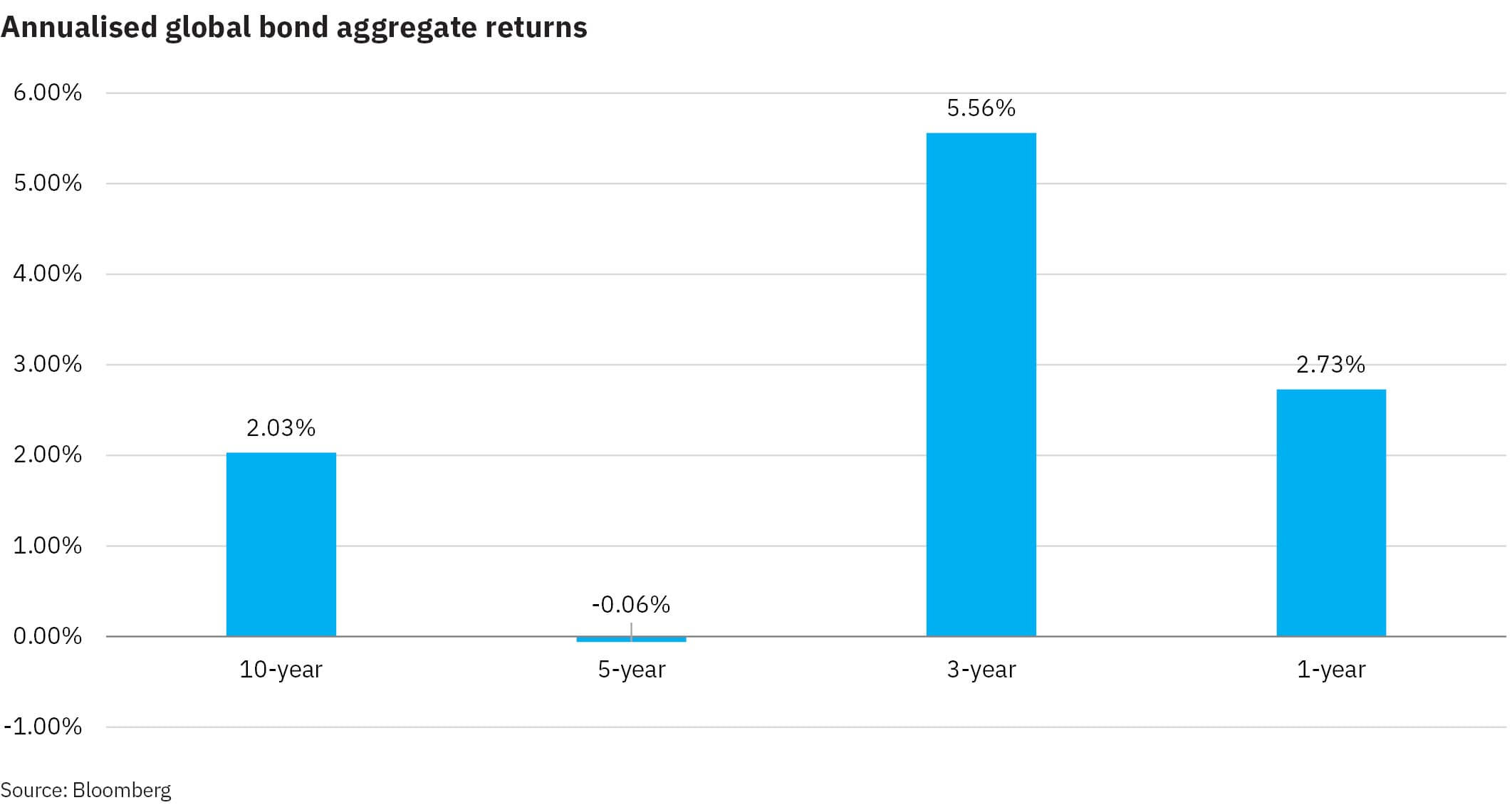
We think this framing, while not without merit, is applied too bluntly and too frequently. A 2% real yield on high-quality fixed income is, by historical and theoretical standards, genuinely attractive – well above long-run equilibrium estimates and far above the negative real rates that defined the post-GFC era. The market is, in our assessment, much closer to fairly priced than the prevailing narrative suggests. But fear sells, and the bond market has proven a lucrative venue for dramatic calls. Each episode of yield overshooting driven by fiscal anxiety or inflation extrapolation creates precisely the kind of entry point that a tactically flexible income mandate is designed to exploit.
Each of those episodes of market angst creates the opportunity to allocate tactically into instruments offering spread or duration that the market has mispriced in the moment. The flexibility to move across the yield curve and across instrument types – from floating rate instruments that benefit from elevated policy rates, to selectively extending duration when term premium compensates adequately – is central to how we add value. Our framework is deliberately simple: we anchor to the observable real returns available on a buy-and-hold basis, and we allow market behavioural episodes to create entry points that improve on that base case.
A structural shift creates a supportive environment for active management
The case for launching a global income fund now is not a macro call on the direction of rates. It is a recognition that the structural environment has shifted in a way that makes fixed income investable on its own terms for the first time in over a decade – and that the transition to a new equilibrium creates a conducive environment for active management alongside the buy-and-hold case. Real yields are positive. The opportunity set is broad. The market will continue to struggle with the implications of the new regime. That is the environment the PSG Global Diversified Income Fund is designed to deliver in.
Share