
Investment Strategy
Building one portfolio from our best ideas: Our total portfolio approach in practice - Angles & Perspectives Q3 2026

A practical look at how we apply total portfolio thinking in the PSG Balanced Fund
The whole is something besides the parts.
Aristotle, Metaphysics (circa 350 BC)
In An introduction to the total portfolio approach, Kevin Cousins sets out the origins of the total portfolio approach (TPA) and why a growing number of the world’s largest asset owners are moving away from some aspects of traditional portfolio construction.
We have been constructing multi-asset portfolios with some unconventional aspects at PSG Asset Management since inception, and while we wouldn’t categorise our approach as a pure TPA one, there is much shared ground. Readers may well wonder what this looks like in an actual portfolio. In this article, we use the PSG Balanced Fund to show how we apply these ideas day to day, drawing on current positions and some examples from the past few years.
It is worth starting with what we don’t do. We don’t set an upfront strategic asset allocation, and we don’t carve the fund up into asset class ‘buckets’ (or asset class sleeves) managed by separate teams against discrete benchmarks. While simple in principle, this has some important (and sometimes surprising) consequences for how the fund looks and behaves.
We start with the return objective and manage risk around it
Our starting point is the fund’s objective: to deliver returns in excess of CPI plus 5% a year, compounded and net of fees, over the long term. That objective sets how much risk the fund needs to take. A real return of that size requires a meaningful exposure to growth assets, and with it the acceptance that drawdowns are likely along the way.
The question we then ask is how best to earn that return while limiting the risk of a permanent loss of capital. We assess the fund’s risks in an integrated way, across asset classes and regions: what drives each holding’s returns, which holdings share the same underlying exposures, and how they are likely to behave together when markets come under stress. A new position is only attractive if it improves the expected outcome for the fund as a whole, once we account for the risks it adds or diversifies.
This is where our approach departs most from a building block portfolio. When each asset class sleeve is measured against its own benchmark, the fund as a whole can end up carrying far more of a single risk than anyone intended, or achieving too little of the return it needs. Measuring every decision against one objective keeps the focus on the outcome that matters to clients.
The factsheet only tells part of the story
A fund factsheet groups holdings by asset class and by where securities are listed. This provides a useful overview of the portfolio and supports regulatory reporting and investor communication. However, understanding the underlying economic exposure of a portfolio may require looking beyond these classifications. A share listed on the JSE can earn almost all of its profits offshore, while the performance of a government bond and a bank share may well depend on the same thing: the direction of South African interest rates.
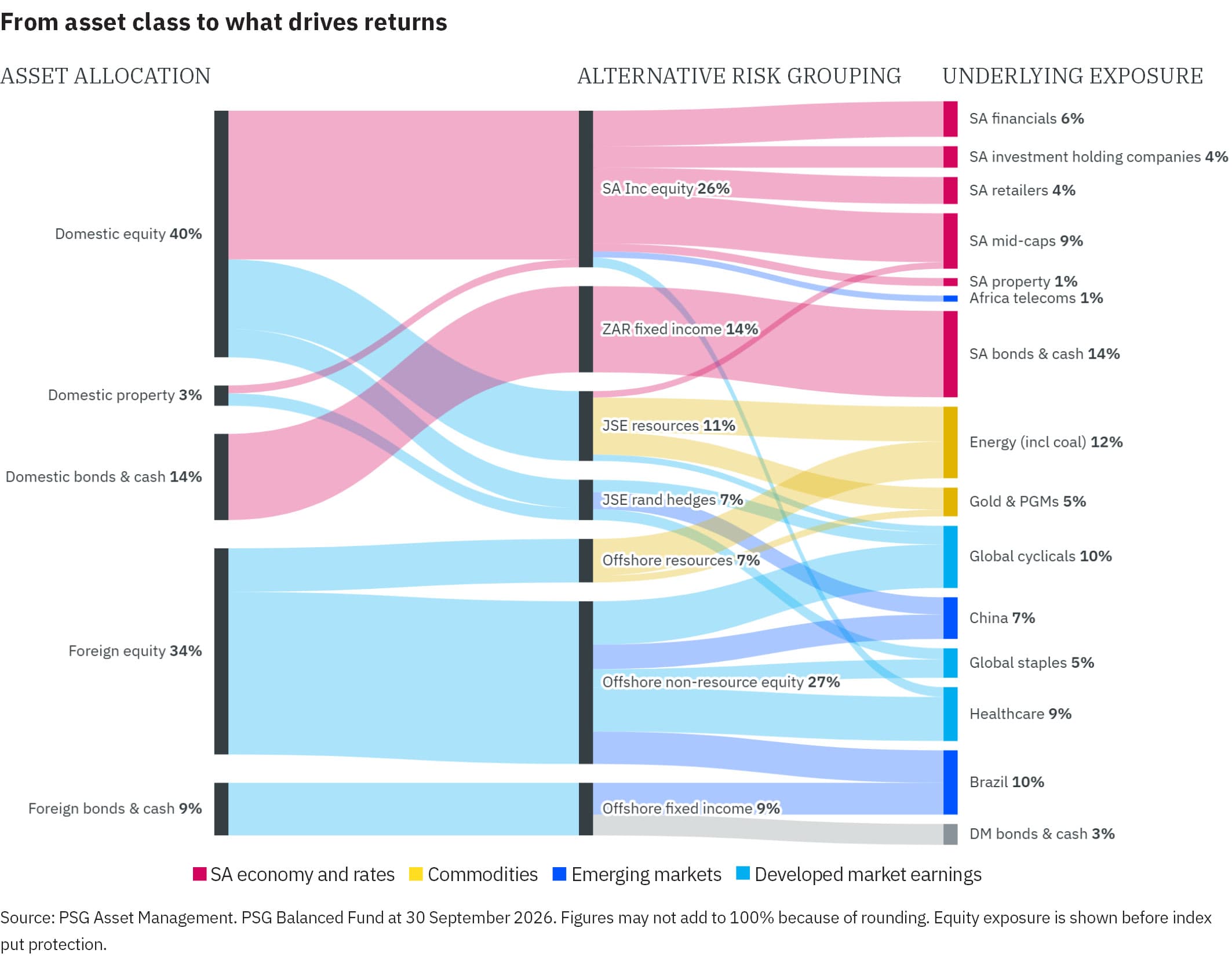
The graphic below traces the fund from its asset allocation, through a more economic representation of the risk, to the underlying exposures we believe drive returns. On the factsheet, over half of the fund is classified as domestic. Yet only around 40% is exposed to the South African economy and local interest rates (SA Inc. shares, local property and domestic bonds). The balance is driven by global earnings, commodity prices and, to a lesser extent, foreign interest rates.
Notably, some of the fund’s more meaningful positions only become visible once you look across asset classes. Our Brazilian exposure, for example, is split between local currency government bonds and shares such as XP Inc., Nu Holdings and B3 S.A., and amounts to roughly 10% of the fund. Our energy holdings (including coal) are spread between JSE-listed counters like Exxaro, Thungela and Sasol and offshore names such as Viper Energy and Petrobras. In a portfolio managed in silos, it is quite possible that nobody would see either position in aggregate.
Every holding has to earn its place
The only top-down constraints we work with are those set by the mandate: Regulation 28 of the Pension Funds Act primarily constrains overall equity exposure to 75% and offshore exposure to 45%. Within those limits, there are no target weights for asset classes or regions. Each security has to compete with every other idea in the fund for its place, regardless of whether it is a share or a bond, listed locally or offshore, or sits higher or lower in a company’s capital structure.
South African interest rates are a good example. Government bonds, banks and listed property all depend largely on the same driver: the level of local rates and the market’s view of the sovereign’s creditworthiness and economic growth. Yet in a typical portfolio approach, the exposure of these assets would all be considered separately against applicable asset class benchmarks, without necessarily recognising the aggregated SA interest rate risk it was taking. We ask instead which instrument offers the best return for that risk. When long-dated government bonds offered yields in excess of 12% (which we regarded as equity-like real returns with no earnings risk attached), the fund preferred holding a large bond exposure offset by smaller positions in domestic bank and property shares. This freed up very useful risk budget that could be deployed elsewhere in the portfolio.
Importantly, every position should play a clear role in the portfolio. Some holdings are there primarily for long-term returns, others to diversify the fund’s dominant risks, and others to protect it against inflation or a sudden market shock. In addition, our willingness to look beyond the benchmark helps us to find sources of diversification a top-down process can often overlook.
Energy is a good example of an exposure that a top-down process is likely to miss, given how small a part it plays in most equity indices (around 3% in the S&P 500 Index). In the PSG Balanced Fund, around 12% of capital is invested in energy-related shares, and they do a job that few other holdings can. We expect good returns from our holdings in the sector in isolation. However, their returns are largely unrelated to the fortunes of the South African economy, and importantly, they tend to do well amid the inflationary and supply-driven shocks that hurt most other assets, as 2022 demonstrated.
Offshore currency plays a similar role. The rand has a long history of weakening when South African assets are under pressure, which means our offshore holdings tend to cushion local losses in rand terms. After a generational sell-off, we currently find the Japanese yen one of the most interesting currencies to own. We therefore view the offshore allowance as an important source of portfolio resilience, and not only as a source of return.
A team structure that supports the process
Our investment team, based in Cape Town, researches and makes decisions on every security in the fund using the same investment philosophy and approach. As we generalist investors, our process enables us to research and rank best ideas from assets as diverse as a domestic mid-cap, a global healthcare business or a Brazilian government bond. We believe this is a necessary condition for an integrated approach to work: without one research process and one set of decision-makers, it becomes very difficult to compare.
We test the portfolio against a range of outcomes
We do not position our portfolios with a single macro outcome in mind. Mindful of the objectives we have for portfolio outcomes and attendant risk considerations, we test the fund against a range of plausible scenarios and aim to size positions so that no single outcome can do lasting damage. The diagram that follows shows how the different parts of the fund are likely to behave across five illustrative scenarios.
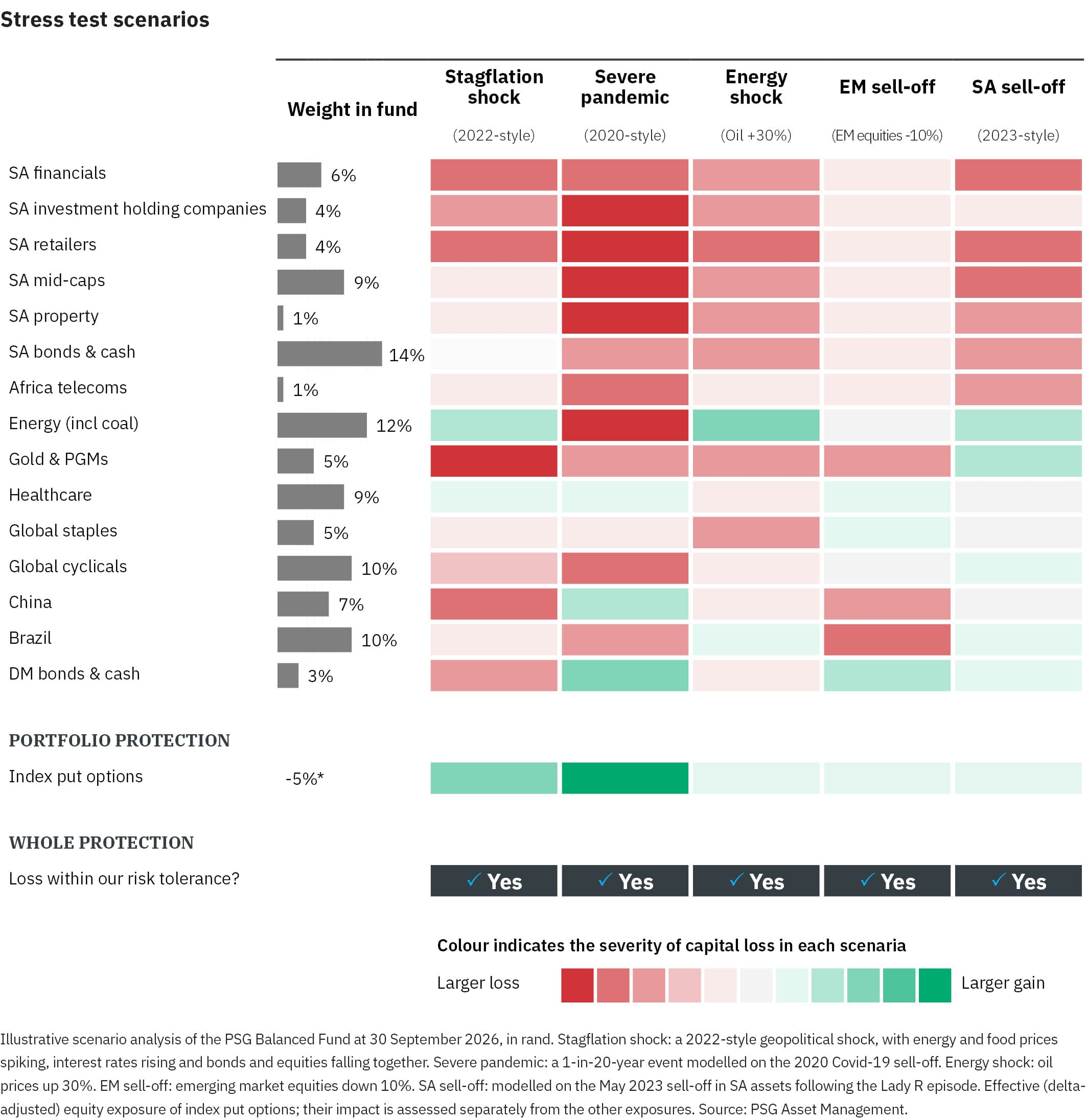
Of course, no portfolio is equally well suited to every environment and in order to achieve long-term return objectives, some risks need to be taken. Tools like this help the team to better understand and measure the true risk exposures in the portfolio, and to combine the right risks.
Protection allows us to stay invested in our best ideas
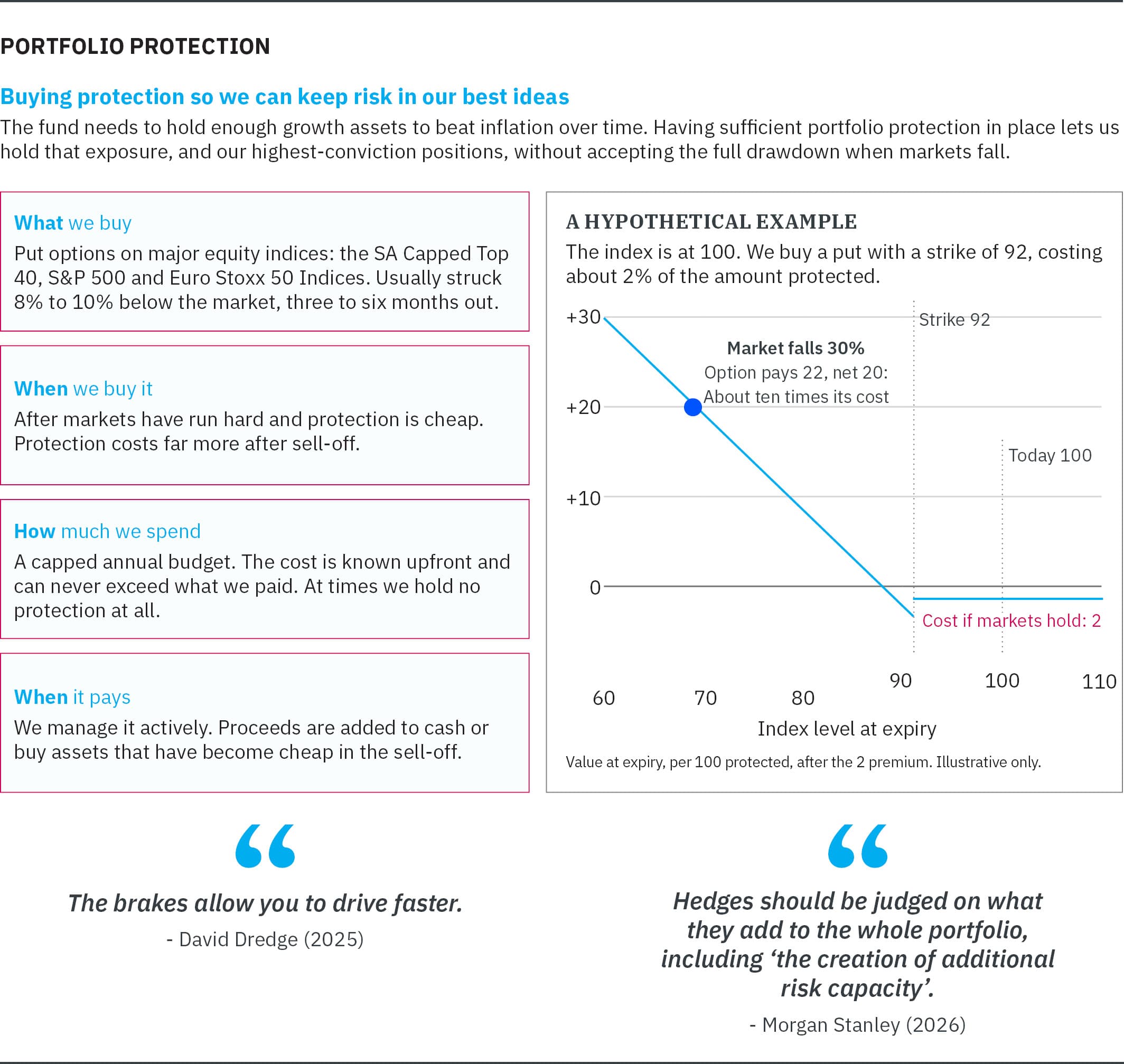
Most discussions on risk focus only on the downside and completely ignore the cost of foregone upside returns. To deliver on our target return of CPI+ 5% p.a. over time, the fund needs a meaningful exposure to growth assets. Put options on equity indices allow us to retain that exposure (and our highest-conviction positions) without accepting the full drawdown when markets fall sharply.
Many investors respond to drawdown risk by holding larger amounts of low-return assets, i.e. ‘driving slower’. The explicit protection provided by our put option purchases enables us to hold more high-return assets, i.e. ‘driving faster but investing in good brakes’.
We tend to buy protection after a strong run in markets, when complacency is high and the insurance is relatively cheap, within a budget that we cap each calendar year. When markets come under stress, we manage these positions actively, and the proceeds can be used to buy assets that have become attractively priced.
Current conditions make this discipline particularly valuable, in our view. Equity indices are concentrated and expensive, credit spreads and implied volatility are low, and a growing share of trading is driven by passive, systematic and short-term participants rather than price-sensitive, fundamental investors. Combined with elevated leverage in the financial system, these are the conditions in which large market moves become more likely.
What this means for our clients
Clients in the PSG Balanced Fund own one portfolio, built bottom up from the best ideas of a single investment team and managed as an integrated whole from a risk perspective. This approach has rewarded our investors over the longer term.
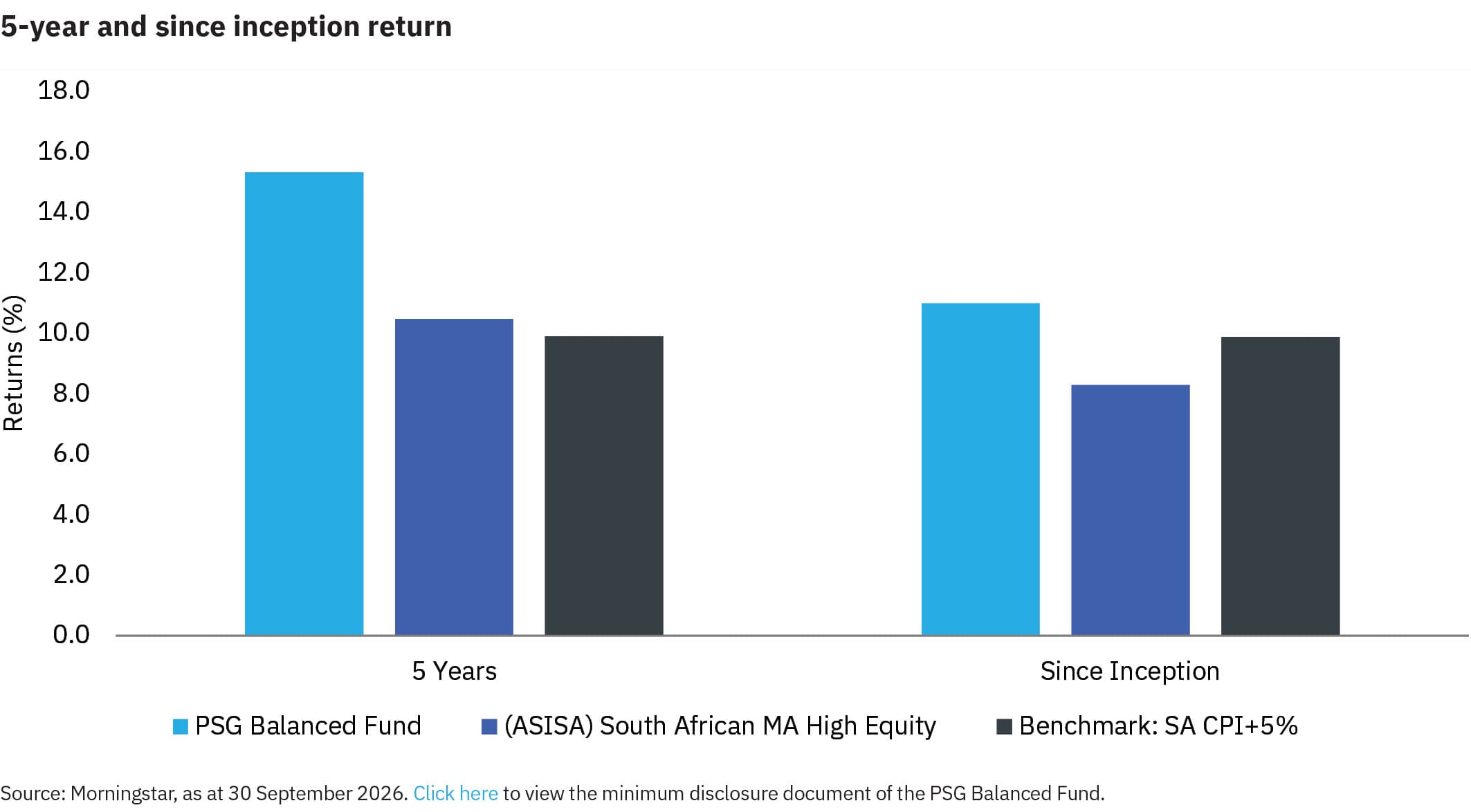
This approach comes with trade-offs, and we prefer to be open about them. The fund will often look quite different from its peers and from the index, and it can lag when a narrow group of index heavyweights runs hard. At present, those themes are precious metals on the JSE and AI-related hardware in the US, where our exposure is modest (which has been uncomfortable at times!). We accept this, as we believe a portfolio built from the bottom up, and tested against what could go wrong, gives our clients the best chance of reaching their long-term goals.
In our view, the growing global interest in alternative approaches to portfolio construction (like the Total Portfolio Approach) is helpful. It gives us clearer language to describe an approach we have followed for many years, and we believe it will become increasingly valuable to investors in the years ahead.
Share