
Investment Strategy
An introduction to the total portfolio approach - Angles & Perspectives Q3 2026

Sovereign wealth funds and university endowments are among the proponents of the total portfolio approach (TPA). We believe the unwinding of long-standing market imbalances erodes some of the pillars that have supported the success of strategic asset allocation (SAA) over the past 30 years. TPA especially lends itself to navigating some of the key challenges a changing environment presents to investors. Our process at PSG Asset Management can be classified as a total portfolio approach, although it resulted naturally from our 3M investment process.
Quick refresh on the ‘building block’ SAA approach
SAA divides the portfolio into underlying sub-portfolios for key asset classes and geographies. Each sub-portfolio is managed by a specialist team. The allocation between the building blocks (the SAA) is handled by another specialist team or consultant. That team is typically also responsible for tactical asset allocation (TAA), or the shorter-term trades around the SAA. SAA has dominated institutional portfolio management over the past 30 years.
Quick refresh on the ‘building block’ SAA approachSAA divides the portfolio into underlying sub-portfolios for key asset classes and geographies. Each sub-portfolio is managed by a specialist team. The allocation between the building blocks (the SAA) is handled by another specialist team or consultant. That team is typically also responsible for tactical asset allocation (TAA), or the shorter-term trades around the SAA. SAA has dominated institutional portfolio management over the past 30 years. |
SAA is built on a strong theoretical foundation, which has driven its popularity
Firstly, Modern Portfolio Theory (MPT) champions the use of mean-variance optimisation in portfolio design.
Secondly, academic research published in 1986 showed that 94% of the variability in pension plan returns was explained by strategic asset allocation (Reference 4).
Most investment processes are benchmark cognisant and quantitative risk modelling is the industry standard, and this has supported MPT and SAA being widely adopted.
The major underlying assumptions for SAA portfolio construction and monitoring
SAA relies on some key assumptions, whose validity is of crucial importance. These include:
The future expected returns for each asset.
The historical average volatility of return for each asset.
The historical average correlation between asset returns.
Any regulatory or mandate constraints to asset allocation.
The SAA process optimises asset allocation between the building block portfolios using these assumptions. Adjustments to the SAA tend to be made incrementally via shorter-term TAA trades.
Specialist teams manage each building block against a tailored benchmark index appropriate for the asset class.
What SAA does well
SAA keeps asset allocation clear and simple. Each asset class is a single building block of the portfolio, with a single expected return estimate and historical risk dataset. Until 2020, asset classes were generally good proxies for the underlying risk drivers.
The whole MPT and quantitative risk framework introduced a common language for discussing portfolio construction and market risk. Risk can be reduced to a single number (for example, ‘volatility of return’ or ‘tracking error’) that is easily comparable.
Clear governance structures enable a disciplined approach ideally suited to harvesting a number of risk premiums over long time horizons.
Each building block portfolio is managed against a tailored benchmark to enable a clear understanding of where risk is taken and where alpha is generated across all the sub-portfolios and hence the whole fund.
Should the key underlying assumptions prove valid over the investment horizon, a well-managed SAA process is likely to deliver a portfolio with a high probability of meeting target returns.
Exploring SAA’s limitations
“…the world that SAA was built for has changed… The correlations and risk premiums that underpinned decades of SAA modelling have proven fragile in an environment of less stable inflation, market concentration and deepening geoeconomic fragmentation.” (Reference 1)
SAA is a very structured process and tends to result in relatively static positioning. The huge increase in macro and geopolitical volatility since 2020 has favoured more dynamic approaches to portfolio construction. Index composition itself can show rapid evolution and dispersion. SAA generally makes incremental adjustments to asset allocation and is unlikely to avoid an asset class altogether, thanks to its building block framework.
Most of the issues around SAA can be traced to circumstances where the underlying assumptions embedded in the process are no longer a good representation of reality. A key assumption is that of static risk – in other words, historical average correlations and volatility are a good representation of future outcomes.
In practice, we know that correlations between asset classes rise sharply during periods of market stress. This is most likely due to rising liquidity needs as, for example, large leveraged funds are forced to reduce overall position sizing as risk asset volatility spikes and the value of their collateral declines.
Forecasting expected returns for each asset is difficult. Small changes in these expected returns can result in big changes in the modelled optimal asset allocation. Single-point estimates of expected returns are treated as precise by the optimiser, making subsequent outcomes vulnerable to deviations from these estimates. Typically, these deviations could be driven by initial conditions (such as extreme valuation or crowded positioning), but on occasion they are driven by whole market regime shifts.
The split into asset classes can provide a very imprecise view of the true underlying risk factors. The overall portfolio’s positioning and risk can be impacted by inadvertent layered bets across the different silos. In addition, each silo’s benchmark is assumed to be representative of the asset class or geography. Should a benchmark become very concentrated, as is happening now with the S&P 500 Index, quantitative risk models will give a poor picture of the true risk in the portfolio.
The origins of an alternative approach
To be clear, SAA has provided a highly successful framework for institutional asset management and remains the dominant approach today. Many asset managers have used knowledge of the limitations discussed above to enable explicit mitigation via the structure and management of their SAA process, and continue to deliver investment returns that meet or exceed their clients’ expectations.
However, an alternative framework is also being developed that seeks to explore how the investment management profession can remain true to the core principles of SAA ‒ such as diversification, a disciplined approach and a long-term orientation ‒ within an architecture that is well suited to today’s interconnected and dynamic environment, characterised by regime shifts, geopolitical instability and volatile macro variables.
TPA
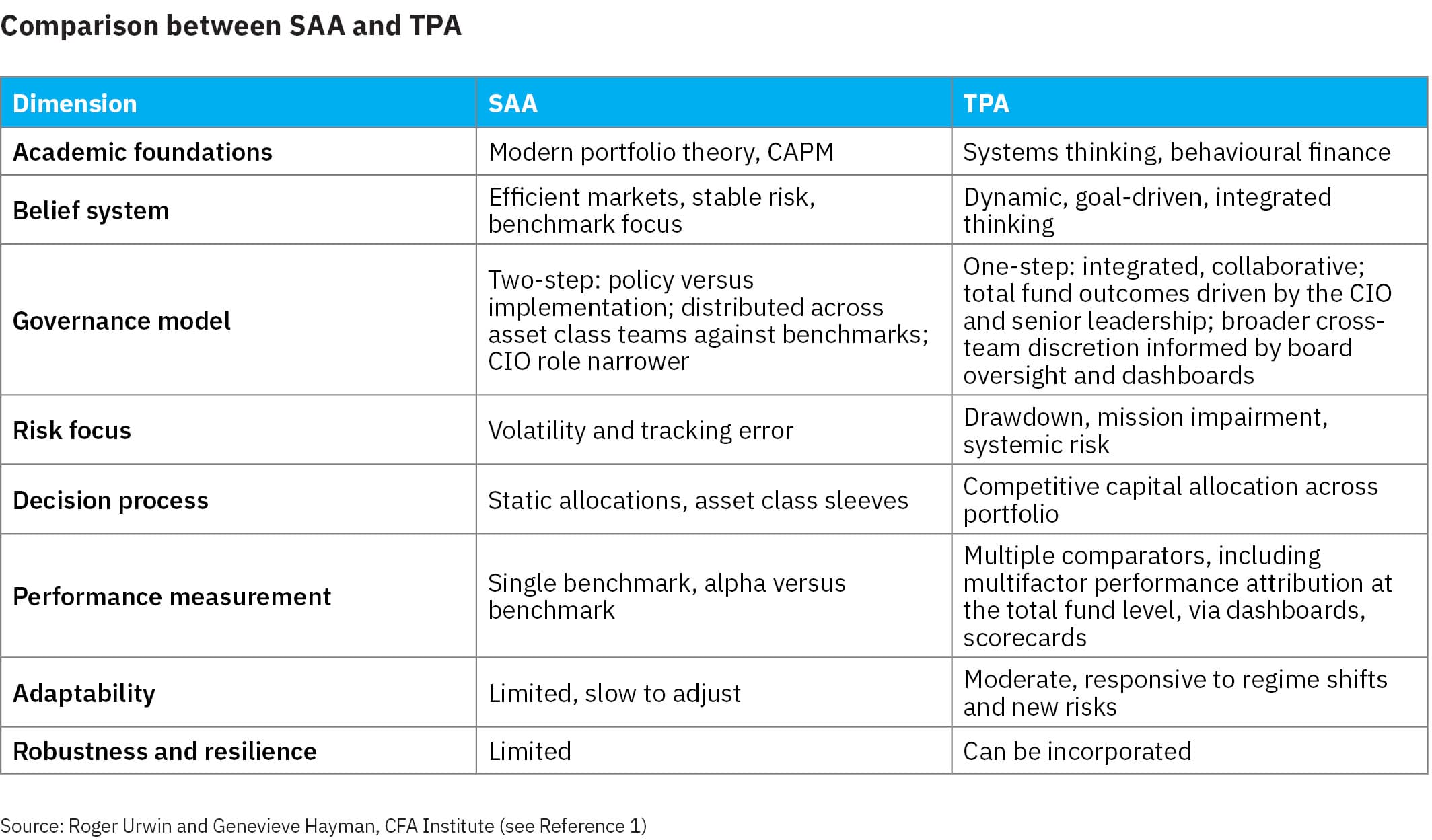
“The total portfolio approach is more than a portfolio construction technique. It is an integrated investment philosophy and decision-making framework. As such, TPA is not a single method to be replicated but a spectrum of practices through which institutions seek to better align capital, risk, measurement and long-term objectives… Whereas SAA is benchmark driven, focusing on policy weights and generating alpha within asset class silos, TPA is goal driven, evaluating investments based on their marginal contribution to the total fund’s objectives, risks and constraints.” (Reference 1)
Some of the defining characteristics of the TPA include:
A team-based and collaborative approach aligned to the investment objectives and focused on best ideas and dynamic decision-making.
Portfolio managers have broad discretion and clear accountability.
Portfolios are focused on achieving the overall investment objective, constructed one security at a time. Each security competes against the entire opportunity set and is selected for a specific portfolio role.
Managers have a much larger opportunity set, with securities from all asset classes and geographies providing ‘more arrows in the quiver’, obviously within the constraints of the mandate. Care is taken to build well-diversified portfolios, with the relationships between all securities being evaluated together, often on a factor basis.
The apparent precision of the mean variance optimisation approach, which optimises portfolios around a single expected return for each asset based on backward-looking data sets, is replaced by a scenario-driven framework. This seeks to evaluate portfolio resilience through stress tests of the impact of a variety of macro and market environments.
Portfolio resilience comes firstly from diversification, avoiding unintended layered bets across asset classes. Non-conventional safe-haven assets play an important role, especially in inflationary or supply shock scenarios that are poorly represented in historical data sets (for example, physical gold and energy stocks). Explicit risk mitigation, such as put options, enables portfolios to hold a larger proportion of high-return assets and still remain resilient in adverse scenarios.
Risk moves beyond volatility of return, with a focus on resilience, specifically drawdowns, systemic risk, regime changes and political risk.
The early pioneers of TPA include the Future Fund (Australia’s sovereign wealth fund) and New Zealand Superannuation (NZ Super). Of the world’s 100 largest global asset owners, 66 use SAA, 8 use the TPA and 26 use a hybrid of the two (Reference 1). The recent adoption of TPA by industry giant CalPERS potentially marks a tipping point.
“Rather than managing portfolios as collections of asset classes, TPA treats the portfolio as a single, integrated entity. Diversification and risk are understood through the lens of underlying unique style factors rather than asset class labels.
“The framework begins with the investor’s ultimate objectives and constraints, then assembles a set of complementary return streams designed to achieve them. Individual investments are evaluated not on a standalone basis, but according to how they contribute to total portfolio risk and return. By focusing on the portfolio as a whole, TPA seeks to eliminate overlapping exposures and improve the efficiency with which risk is deployed.” (Reference 3)
Our TPA journey at PSG Asset Management
It has been fascinating to see some of the world’s largest managers embrace an investment approach so similar to how we manage portfolios at PSG Asset Management.
Over the past two decades, we have steadily built out our capabilities to manage local equities (our starting point), global equities (for nearly 20 years now), local fixed income, credit and real estate, and more recently, global fixed income. Our process has also enabled us to repeatedly take advantage of global real estate and credit opportunities. We run one research process across local and global assets.
While we have a long track record of delivering alpha across all these asset classes, each portfolio is managed as an integrated whole, built bottom up via security selection from all the asset classes available to the mandate. While the process has been many years in the making, the incremental improvements since 2020 as our research capabilities broadened and we responded to the changes in the macro environment, have been meaningful.
Why TPA thinking works well at PSG Asset Management
We believe our culture and organisational structure are of prime importance. Broadly, our version of TPA developed naturally over a long time:
We have a team-based and collaborative investment process with a low-ego culture.
We are generalist investors. Our 3M philosophy can be applied to any asset and our team does bottom-up research across many sectors, geographies and asset classes.
Portfolios are built from our best bottom-up ideas, with a focus on understanding what each asset brings to a portfolio. Bottom-up research works around a range of outcomes for each security.
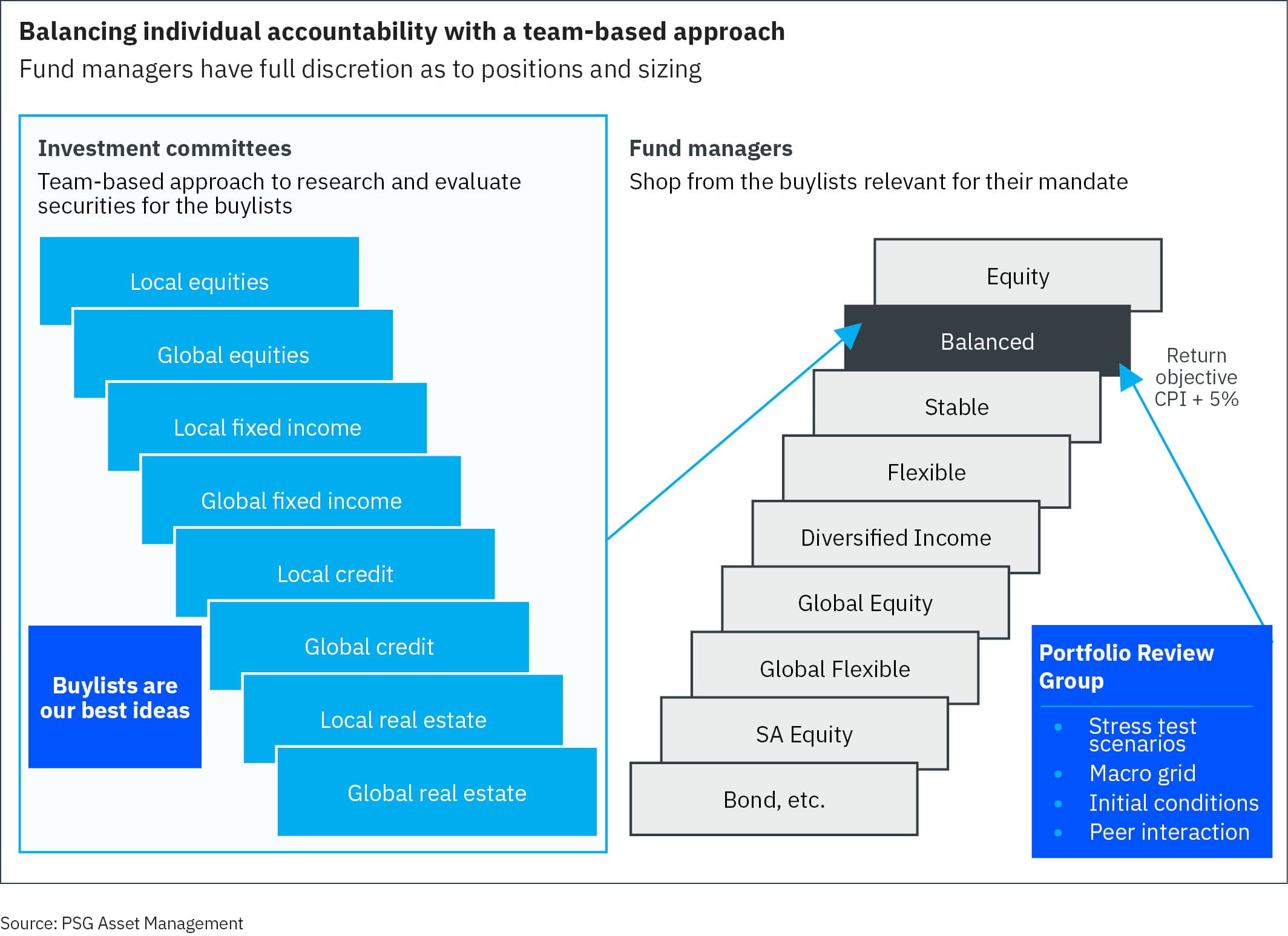
Portfolio managers have full discretion in managing their funds and can shop from our best ideas across a much bigger opportunity set.
We do not do macro forecasts or single-number expected returns for assets. We rather use a variety of macro scenarios to stress-test portfolio resilience.
We can view risk across the whole portfolio, enabling innovative offsets and more efficient structuring. We use explicit downside hedging rather than relying solely on diversification.
The diagram below illustrates our TPA approach. The PSG Balanced Fund provides a good expression of this process, as it is a multi-asset fund that can invest locally and globally.
The drawbacks of TPA thinking
There are always trade-offs in the investment business!
Our portfolio managers have full discretion, so their cultural fit with the team-based approach and our low-ego, evidence-led culture is essential. That discretion comes with clear accountability. Our Portfolio Review Group provides a rigorous peer group review of individual mandates with each fund being measured against its benchmark, its peer group and an inflation-linked (CPI+) real return target over our investment horizon.
Many clients use SAA/silos, so our best representations of our process may not suit their needs.
Many clients focus primarily on benchmark-relative performance metrics, often over shorter periods than our investment horizon. As we follow a primarily absolute return process, we are likely to deviate significantly from benchmark returns, especially when indices become very concentrated. In response, our process has become more ‘benchmark aware’, with the use of quantitative risk models as one of our data inputs.
On occasion, clients’ view of risk is not aligned with ours. They often focus on volatility and Sharpe ratios, rather than downside volatility and drawdowns ‒ measures which we believe are more valid. It is important to build an understanding that constraining upside volatility is very detrimental to long-term performance.
We expect an increasing focus on TPA
The global rise of the TPA is of great assistance to us in clearly articulating our process and philosophy in a way that builds clients’ understanding of what we do.
Our investment process has always given portfolio managers discretion to build their portfolios from our best ideas, generated by bottom-up research across all local and global asset classes relevant to their mandate. Since 2020, as our research capabilities broadened and the macro environment became much more volatile, our process has developed significantly. In particular, our Portfolio Review Group and risk architecture complement the research and portfolio management process, together making up the heart of our total portfolio approach.
In the next article, Building one portfolio from our best ideas: Our total portfolio approach in practice, Justin Floor unpacks how this process works practically, using the PSG Balanced Fund as an example.
References:
The Total Portfolio Approach (TPA): A Practical Guide for Navigating the Transition to TPA, Roger Urwin, FSIP, and Genevieve Hayman, PhD, CFA Institute July 2026
Portfolio Resilience: Part One, Future Fund Position Paper November 2025
Beyond Asset Allocation, Vishwanath Tirupattur, Stephan Kessler, Morgan Stanley July 2026
Determinants of Portfolio Performance, Brinson et al. Financial Analysts Journal, July/Aug 1986
Share