
Investment Strategy
Why a differentiated approach is valuable in an era of unprecedented market concentration

We are living in an investment era of extreme concentration. Global financial assets are concentrated in the US, accounting for 64% of the MSCI World All Country Index, despite the US only contributing around 25% of global GDP. Passive investing now dominates market flows, contributing to rising market concentration. This also means capital is increasingly being funnelled into the largest companies, which have benefited from price-insensitive investing, supporting their historic price performance at the expense of smaller companies.
US stock market is becoming very lopsided
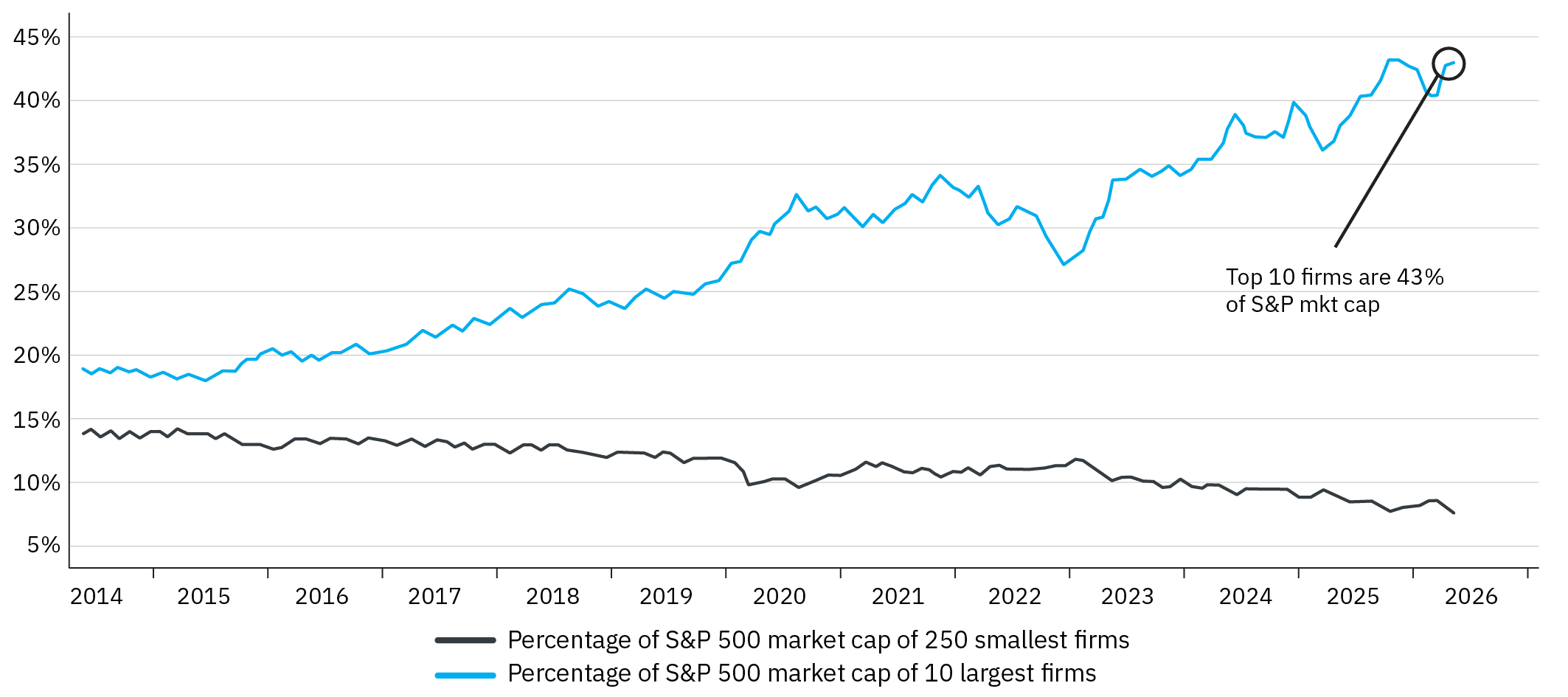
Within equity markets, a singular theme (AI) has come to dominate all the tech-heavy indices, especially in the US. By some measures, AI-related companies now comprise almost half of the market capitalisation of the S&P 500 Index.
Concentrated markets channel assets into a narrow selection of winners
As a result of the extremely concentrated structure of financial markets, the bulk of global capital is effectively betting on a continuation of some of the recent trends that have rewarded investors, namely: outperformance by the US, large caps and artificial intelligence (AI) stocks. Given the extent of outperformance and concentration in indices, truly differentiated investing has become scarce. This increases the portfolio benefit of including less-correlated active managers.
The PSG Asset Management process is unapologetically bottom-up. This means that our clients own stocks that have made it through our rigorous 3M investment process on merit. We consider and upweight portfolio characteristics, including diversification benefits and size in an index. But we are happy to look different to an index when our process guides us in that direction, adopting a contrarian view when needed. In particular, our happy hunting ground is in what we refer to as ‘mispriced quality’ – usually stocks that are out of favour with the market. It’s a case of being brave when others are fearful. Our analysis is focused on identifying a qualitative feature of the industry or company that the market is undervaluing. We are very careful not to overpay for an asset, always trying to buy with a margin of safety. This approach tips the odds in the favour of our clients in the long run, and has generated solid and consistent results. However, a willingness to bet away from the herd does require both patience and resilience in the face of possible shorter-term underperformance.
Not owning what is popular, can cause some discomfort – but delivers results in the long term
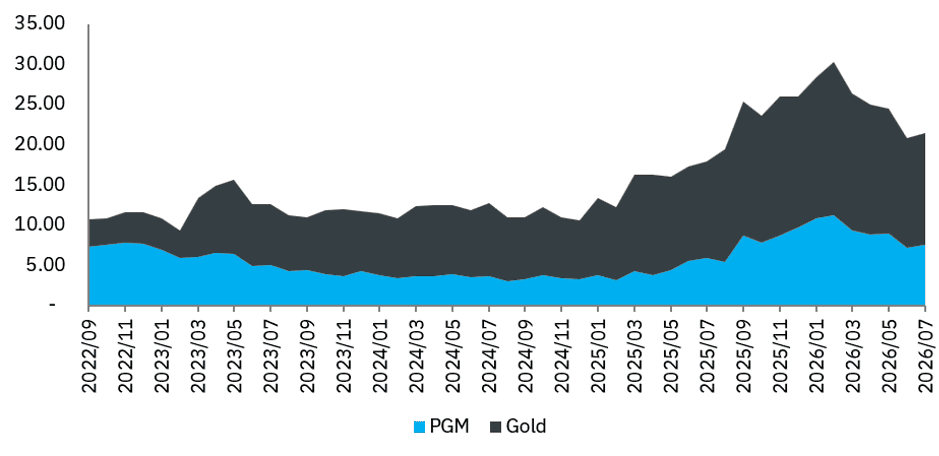
Concentrated markets tend to arise after explosive outperformance by a sector. This is exacerbated by the rising impact of passive flows which allocate more to recent winners. Typically, portfolio positioning at any point in time reflects market participants’ tendency to extrapolate recent experience. This is the trap. For example, precious metals went from 10% of the FTSE/JSE Capped All Share Index four years ago to 30% as at the end of February 2026. Given the career risk of betting away from such a large part of the index, the average portfolio had more exposure to precious metals in February this year than a year previously – effectively concluding that these stocks offer a better risk-reward trade-off than a year previously, despite the fact that stock prices had increased dramatically. Precious metal stocks have endured sharp drawdowns since the February peak and now comprise a third less of the index.
Precious metal weighting in the FTSE/JSE Capped All Share Index (%)
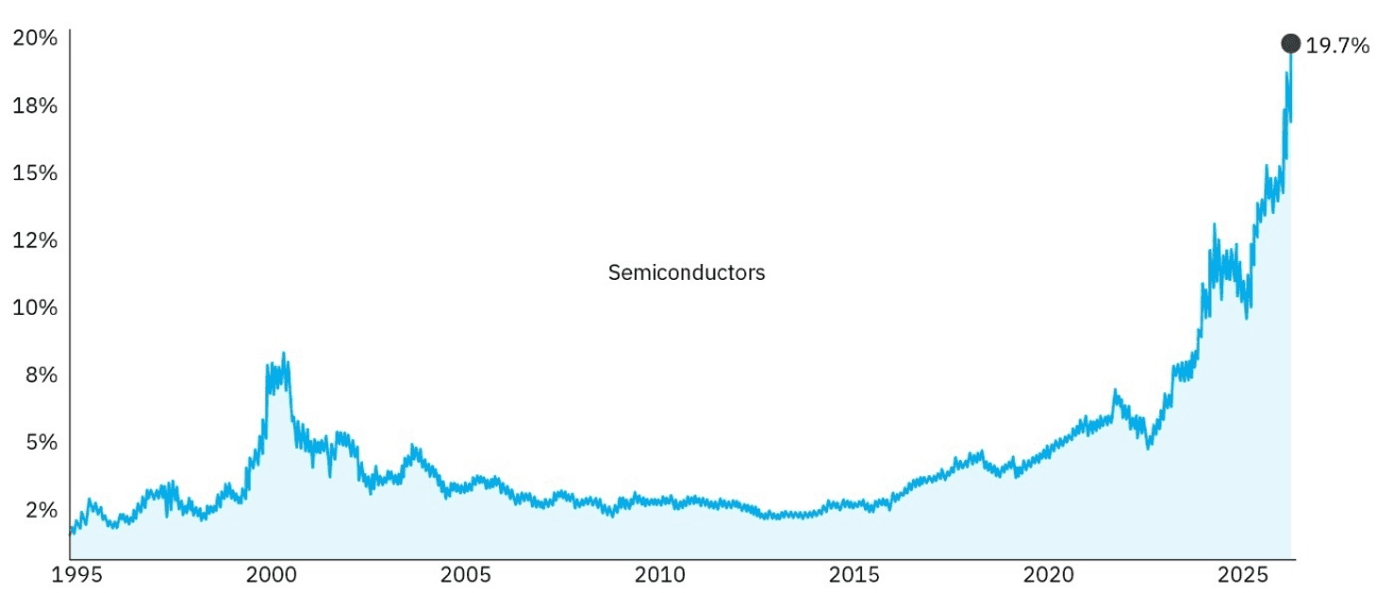
Similarly, semiconductors (the main beneficiaries of the recent explosion of AI capex) went from around 5% of the S&P 500 Index to 20% recently. And after a stratospheric rise in share prices, semiconductors also became the most crowded trade in the Bank of America Fund Manager Survey history as at the end of June, meaning that the average investor had much more exposure after the massive price rise than before. Markets typically mean-revert at some point and while betting against the herd is painful at the time, it gives rise to the opportunity to generate strong future returns and manage portfolio risk.
Semiconductor weight in the S&P 500
Since 1995
PSG Asset Management has been investing directly offshore since 2008, following a globally integrated process. This means that our team of investment professionals is analysing and comparing global and domestics stocks and constructing diversified portfolios that meet mandate risk and return objectives. There are several good historical examples of identifying excellent return opportunities when sectors or stocks have fallen deeply out of favour. A classic example would include buying Microsoft on 10 times earnings in the aftermath of the euro crisis of 2011, a time when investors were lamenting the death of the PC. Embracing the fear then paid handsomely, and Microsoft turned out to be a material contributor to subsequent client returns.
Today, we are again finding opportunities in areas where the market is fearful
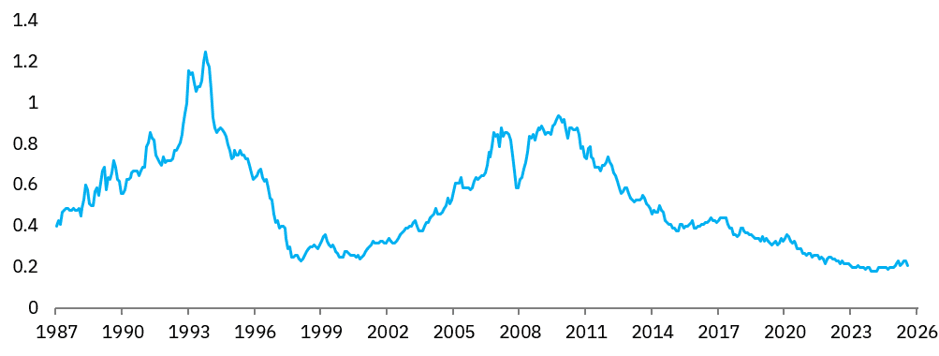
Unsurprisingly, we have identified several pockets where the market is fearful and opportunities are abundant. The US stock market strongly outperformed the emerging market index for 14 years up until the end of 2024. At that point in time global portfolio positioning generally reflected an all-in bet extrapolating this cycle of ‘US exceptionalism’. Our portfolios had dramatically decreased US exposure in the preceding years and increasingly allocated to out-of-favour markets, including emerging markets. This process is ongoing and our research process is identifying excellent value opportunities in neglected markets like the UK, Brazil and China.
MSCI Emerging Markets / S&P500
Specifically, Brazil is shaping up to be fertile ground for attention for 3M ideas. There is a lot of political fear and an upcoming election, the currency is weak and real interest rates are amongst the highest in the world. The high cost of capital and lack of confidence have resulted in very attractive valuations that provide a strong buffer against future shocks. Our buy list now contains several high-quality domestic Brazilian champions that stack up well against other global opportunities. The attraction is enhanced by the likelihood of a rate cutting cycle (at a time when other central banks are probably hiking) and provides the opportunity to diversify our emerging market exposure and make it less SA-dominated without forsaking upside.
The energy sector found itself deeply out of favour at the start of the year. Our portfolios had healthy exposure, as our research indicated deeply asymmetrical bottom-up opportunities in oil, gas and offshore services as well as underappreciated portfolio hedge characteristics. Energy stocks have outperformed year to date, but we still perceive excellent value amidst widespread complacency that energy prices will sustain low levels in the aftermath of the Iran war.
The explosive emergence of AI is causing significant uncertainty, likely disruption and material new benefits for a variety of industries. This is giving rise to both risk and opportunity. Markets are taking firm views on outcomes. In some cases, stocks look like they are being priced for very bad and unlikely disruption. In other cases, investors appear to be extrapolating unsustainable (and cyclical) levels of earnings on the back of aggressive data centre rollouts. There will be companies that will productively use AI to cut costs, enhance products or open up new markets. It should come as no surprise that our investment process is spending a lot of time trying to understand the likely medium-term impact of AI on investment markets. We are adamant that open-mindedness and humility will be rewarded in time, as the ranges of outcomes are wide.
Extreme levels of concentration are a classic feature of late-cycle equity bull markets. When mean reversion eventually takes place, many investors will have to endure very poor future returns. We think investors should prepare for this eventuality by being willing to look different to concentrated indices and focusing on the winners of the future rather than the winners of the past.
This article first appeared in Glacier's Funds on Friday publication.
Share