
Investment Strategy
The normalisation of deviance

US policymakers have chosen to dampen economic and interest rate volatility repeatedly over the past two decades. They opted to consistently support growth and financial markets via fiscal deficit spending, abundant money printing and low real rates. The consequences of these decisions to suppress short-term economic volatility has been the consistent build-up of imbalances in the global system.
Given that this build-up has been going on for many years, and has to date not carried a significant economic cost or caused a clearly identifiable impact on financial markets, most market participants tend to ignore it. While they typically cite the reserve currency status of the US dollar (USD) and the size and importance of the US treasury market, we think the real reason stems from habituation of risk. The imbalances have been talked about as a potential risk for many years, but the fears were never realised. Therefore, it is a risk the market feels comfortable ignoring.
The normalisation of deviance: Diane Vaughan is a sociologist. In her 1996 book ‘The Challenger Launch Decision’ she described how repeated exposures to risk without consequence reduced a group’s perception of the severity of the risk. A risk may remain severe even as people habituate to it.
We believe the substantial imbalances in the US are, and will be, of crucial importance to the future macroeconomic environment. We see probable scenarios of very different fund flows than what the market has grown accustomed to significantly impacting prices, especially in periods of market stress.
Investors’ global portfolios are often optimised referencing look-back periods dominated by this volatility suppression by policymakers. This means they could end up being highly vulnerable to a very different environment in the future, where historic asset correlations will be a poor framework for navigating financial market cycles.
Recessions normally play an important role in keeping the economy and markets healthy
Economies need recessions to remain healthy and to ensure resources are transferred from failing enterprises to those with attractive growth potential. The defaults of those failing firms also help to ensure levels of gearing are normalised. Likewise, financial markets need periods of sharp risk reduction to eliminate the speculative excess that is an inevitable backdrop to long bull markets. These are not controversial statements.
Keynesian economics guided governments to spend counter-cyclically, increasing deficits when times were tough for the private sector, but also running a surplus when economic growth was strong. However, the last time the US had a budget surplus was during Bill Clinton’s second presidential term, between 1998 and early 2002. This was not a deliberate presidential policy: Congress was controlled by the Republicans during this period, who are ruthlessly opposed to big deficits, but only when they are in opposition rather than controlling the White House.
Considering the mid-term and presidential election cycle, the US effectively goes to the polls every two years. No political incumbent wants to go to the polls during a recession. That backdrop may explain why over the past 25 years, every effort has been made to mitigate the impact of any economic slowdown. Policymakers have used massive fiscal transfers combined with low (and negative) real interest rates at the first signs of economic stress. Recessions are becoming rare events.
US recessions: Frequency and duration
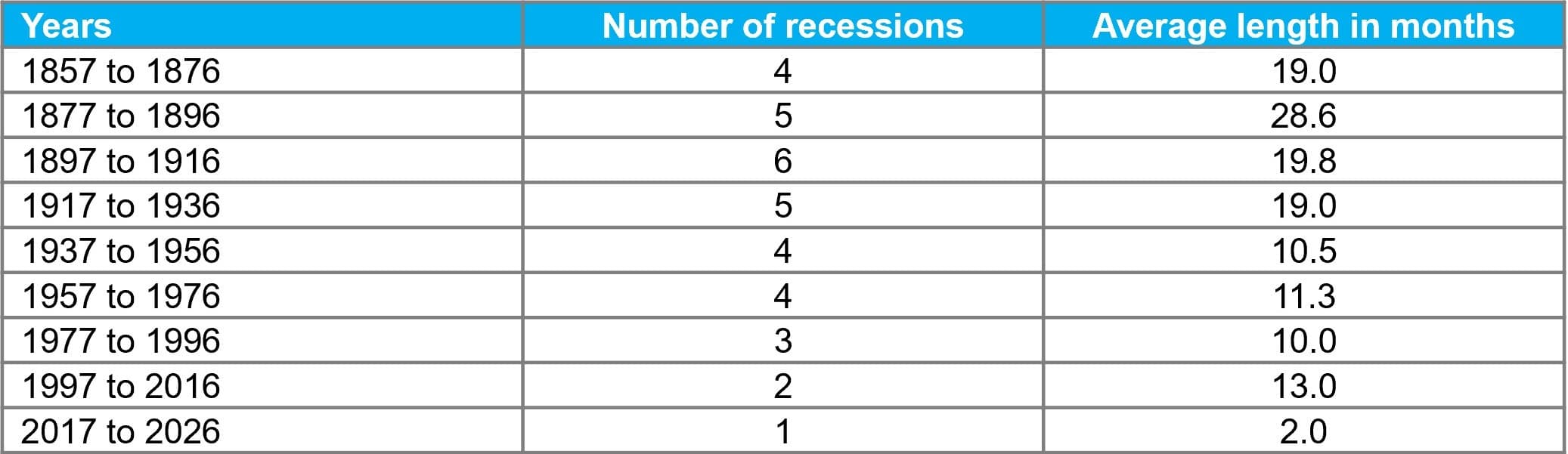
However, reducing spending (which impacts growth) and returning the fiscal position to a budget surplus in good economic times, has not been a priority. Contrary to the Keynesian philosophy behind anti-cyclical spending, fiscal deficits have remained through the entire cycle.
Persistent deficits can result in non-linear outcomes
The growth benefits of more government spending and wider fiscal deficits are immediately apparent, but the costs may take many years to surface, and certainly have extended beyond the time frame of the US presidential cycle. In fact, much of the past decade’s growth differential between the US and other developed markets can be attributed to policymakers being prepared to run bigger deficits. However, there are powerful feedback loops involved with the build-up of imbalances, which in due course can result in surprising non-linear outcomes.
When Clinton finished his second term in 2001, the net federal debt outstanding was just over 30% of GDP (marked on the chart below). This year it will breach 100% of GDP, a level last reached in 1945 at the end of the Second World War. The first feedback loop is fairly obvious, and is already well advanced. As the debt burden grows, all else being equal, debt service costs take up a bigger and bigger proportion of the budget, making the fiscal deficit worse, in turn requiring more borrowing. The US Bureau of Economic Analysis (BEA) data shows government interest payments in the second quarter of 2026 at US$ 1.25Tr (at a seasonally-adjusted annual rate), considerably more than the amount spent on defence.
Unfortunately, all else is seldom equal. The second feedback loop comes from the higher debt levels and worsening deficits, which are not risk factors that the fixed income market can ignore. Should policymaker credibility be called into question, the yield curve will reprice, further raising the interest burden as debt is rolled at higher rates. While the curve has repriced from the lows of 2021, what is notable is the large size of the recent deficits and the corresponding acceleration in the pace of growth in the debt burden. US policymakers seem determined to test the limits of the market’s tolerance.
US net Federal debt to GDP %
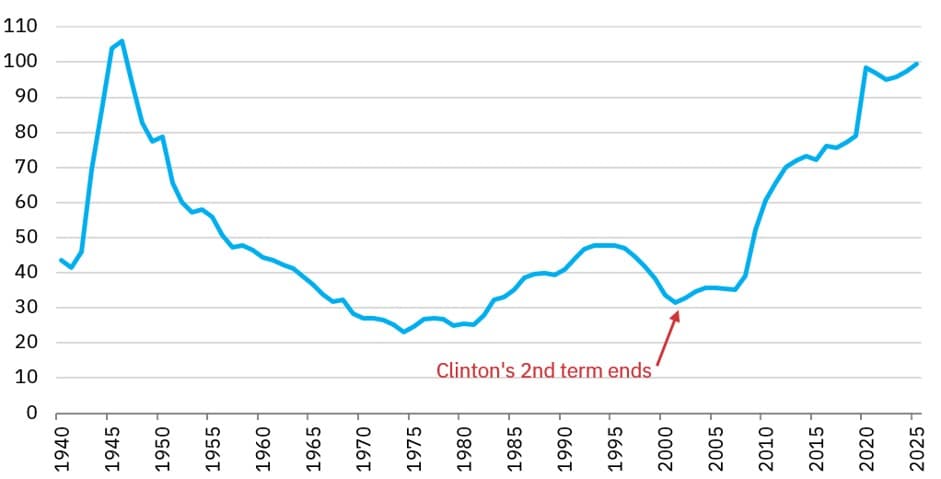
No credible plans have been put forward by either the Republicans or the Democrats to return to fiscal sustainability. During previous periods when US government bonds offered comparable yields to current levels, there was a very low or even no budget deficit and debt/GDP was one-third of where it is today. Thus, we would caution investors against expecting US long bonds to fulfil the safe-haven role they have in the past during periods of market panic.
The current account and the net international investment position
The US current account has been in deficit for over 40 years. It has become consensus that, as the US dollar is the reserve currency of the world, there are no market restrictions on the US balance of payments and that a persistent deficit is sustainable. However, each year’s current account deficit is balanced by a capital account surplus, representing a net flow of foreign investment into the US. The accumulating capital balance that offsets the current account deficit each year is the net international investment position (NIIP): the US’s offshore investment assets less foreign holdings of US investments. This net US liability has grown very large. However, as long as foreigners have been willing to both hold their existing US investments and buy additional assets each year, the current account deficit could be funded with little impact on the USD exchange rate.
Currently, the NIIP is a liability of US$21.3 trillion, about 67% of GDP. Of that, some US$18.2Tr is the net portfolio investment liability, representing liquid investments. As the chart below shows, that has expanded very rapidly, from 35% of GDP in 2018 to 57% currently.
US international investment position
Net portfolio investment % of GDP
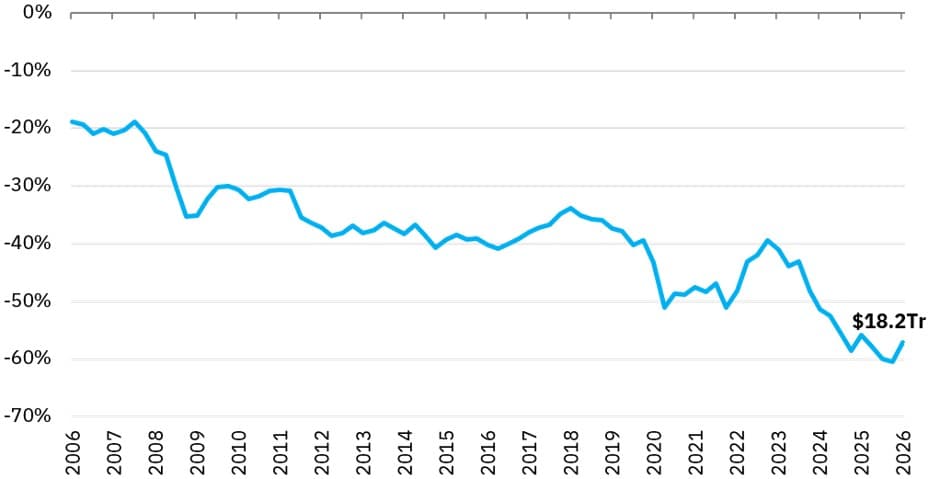
A huge repatriation liability
We believe a good framework to think about the NIIP balances is to consider them as ‘repatriation liabilities’ and ‘repatriation assets’. The US has an enormous repatriation liability and Japan, China and Germany have large offsetting repatriation assets. There are many reasons why foreign investors may decide to reduce their huge investments in the US, including concerns about valuation or future growth, a decline in trust in US policymakers, domestic regulations and prudential guidelines, and the tax treatment of offshore holdings. But the key point is that he accumulated liabilities are now so enormous that the flow from even a marginal reduction in exposure could cause significant market moves in asset prices and currencies (for reference, the US current account deficit is about US$1Tr per year).
The actual exposures are much bigger than the net position. US investors’ offshore portfolio holdings total US$19.2Tr, while foreigners’ US portfolio investments are US$37.4Tr (giving the net US$18.2Tr liability above). The circumstances reducing foreign investors’ confidence that their US assets will prove to be good investments are in many cases also likely to see US-based investors deciding to increase their foreign exposures. This means the gross exposures, not the net ones, are relevant. A 10% decrease in foreigner US portfolios coupled with a 10% increase in US foreign portfolios would lead to a flow of US$5.7Tr or 17% of GDP! While this would of course not happen overnight, even if the adjustment took several years to play out, the price implications are significant.
Investment implications of the imbalances for global portfolios
The ‘Liberation Day’ tariff announcements in April 2025 and subsequent market dislocations illustrated how a risk-off period could unfold, with the S&P 500 declining, a weak USD and weaker US Treasury prices (higher UST yields). This ‘triple combo’ decline was contrary to conventional wisdom and 30 years of back-testing, and provides a very interesting preview of what could happen as the market starts to price in the impact of the accumulated imbalances we have discussed here.
Firstly, the portfolio safe-haven role of long-dated USTs is threatened. In a risk asset sell-off and growth scare, any bond price move is likely to be too fleeting to be an effective portfolio hedge. Investors will quickly shift focus to the impact on the deficit, which is likely to increase by 5 to 8 percentage points in a recession, reaching a horrendous level of 11% to 14%. The implications of the related increase in the debt burden for the ‘market clearing interest rate’ to fund bond issuance are clear.
Secondly, the impact of a significant repatriation of foreign capital on asset prices in the US, the USD exchange rate and asset prices globally, is of crucial importance. A strong USD during ‘risk off’ periods is no longer a given, and ‘when the US sneezes the world catches a cold’ may now be a poor rule of thumb.
Sectors historically considered high risk, such as energy, metals and mining and selected emerging markets, could deliver valuable idiosyncratic returns for portfolios off their currently attractive valuations.
This article first appeared in Glacier's Funds on Friday publication.
Share