
Investment Strategy
Why diversification feels wrong when you need it most

It is well understood that investor behaviour is one of the key drivers of the outcomes investors achieve in the long run. However, while the importance of not selling during a market downturn is often spoken about, the way in which periods of strong market performance can erode investor discipline – especially when a handful of winners are dominant – is discussed less often. Nevertheless, we believe that diversification may become most valuable precisely when investors become most complacent about its value, especially in the face of surging markets.
A compelling narrative and market momentum can heighten investor complacency
Periods of strong performance tend to create confidence, attract more investors and drive prices higher. They are also often accompanied by a compelling narrative that helps explain why the winners should continue winning. As capital flows towards a relatively small group of companies, indices can become increasingly concentrated, particularly in an environment where passive investment flows allocate more capital to the largest constituents. Over time, it can feel entirely reasonable to increase exposure to what has already worked well.
Such dynamics can persist for extended periods. History suggests that this is often when diversification becomes most difficult to maintain, and potentially most valuable.
Current market concentration levels exemplify the problem
The US exceptionalism narrative has dominated markets since the Global Financial Crisis (GFC). The US weight in the MSCI World All Country Index has grown to 64%, despite the US only contributing around 25% of global GDP. But even within the US itself, we have seen growing levels of market concentration. Artificial intelligence (AI) now dominates all the tech-heavy equity indices, especially in the US. By some measures, AI-related companies now comprise almost half of the market capitalisation of the S&P 500 Index.
Investing in an index does not automatically translate into credible levels of diversification
When an index is dominated by a handful of constituents, as is currently the case, it can no longer be assumed to provide sufficient diversification to investors to mitigate the risks. Thus, a deliberate approach to diversification is crucial. But mustering the will to consciously diversify a portfolio also implies the decision to buy assets that are not currently top performers.
This is where diversification becomes uncomfortable: it often means owning assets that do not make investors feel particularly confident today. But that might be exactly the point. Diversification is not designed to maximise participation in a single outcome. It is designed to improve the resilience of a portfolio across a range of possible outcomes. As we have argued before, investors are usually best served by avoiding portfolios that rely on a single forecast, narrative or market outcome to succeed.
Rising levels of concentration in US markets
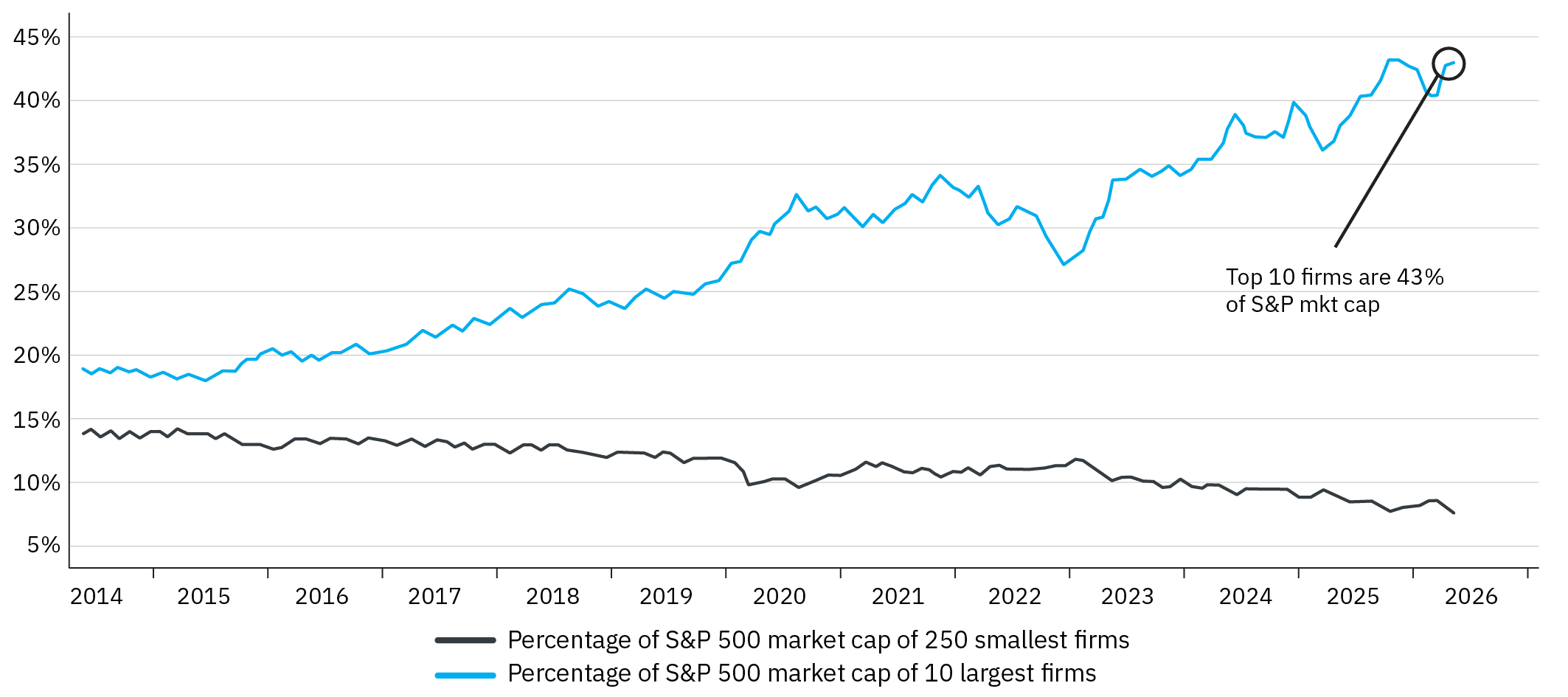
The narratives that support these companies are highly convincing, and in many cases the underlying companies are genuinely exceptional businesses. However, the challenge is that markets not only price what a company is today, but also what investors believe it can become. In many cases, these companies are priced for perfection, and vulnerable to being punished should their performance fall short of lofty expectations. In addition, there are mounting concerns about high levels of interconnectedness between hyperscalers and the chip companies who are simultaneously each other’s suppliers, customers and investors. It seems entirely feasible that the market could reassess the attractiveness of the valuations that have been placed on these companies, if conditions change.
There are compelling opportunities in less crowded areas of the market
Fortunately, for active investors, the extent to which capital has shifted into US markets and the AI theme means that many areas of the market have been overlooked and are trading at compelling valuations.
We believe it is crucial to remain open-minded about the opportunities that the market may be currently overlooking, are unpopular or temporarily out of favour. Some of the most attractive long-term opportunities emerge in areas where expectations are low and valuations already reflect a great deal of pessimism.
This requires patience and a willingness to look beyond prevailing narratives. It also requires accepting that opportunities rarely feel obvious at the time they present themselves. In fact, some of the best opportunities often appear precisely where others are unwilling to look.
That is why, at PSG Asset Management, we keep on patiently applying our proven 3M investment process, supported by our in-depth research and independent thinking, with the aim of constructing resilient portfolios for our clients that are well positioned to navigate a variety of macro scenarios.
This approach has delivered well for our clients so far, and we remain confident that it will continue to do so into the future.
Share