Fraudulent Telegram and WhatsApp groups
Please beware of fraudulent Telegram and WhatsApp groups impersonating PSG Financial Services, our divisions and our advisers. Be cautious, verify links and contact your adviser or Client Services if you have any queries or concerns.
12
February 2025
Addressing client needs by seeking both performance and trust - Angles & Perspectives Q4 2024
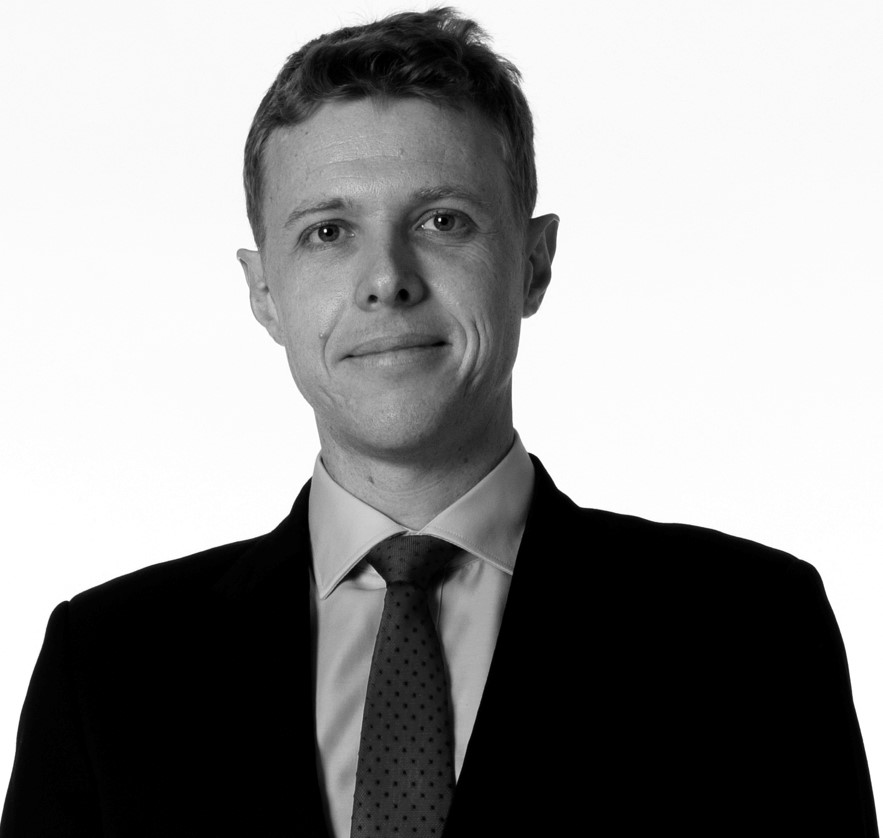
Justin Floor, Head of Equities
Asset Management

“ “Trust is the glue of life. It’s the foundational principle that holds all relationships.” — Stephen R. Covey ”
Addressing client needs by seeking both performance and trust
What justifies the existence of investment managers in an era of index funds, robo-advisers and relentless market noise? Today, clients are inundated with options, yet the core challenge remains unchanged: achieving real, inflation-beating returns over decades, not quarters. This demands more than technical skill – it requires a partnership forged on trust, patience, and the courage to defy consensus.
Investment manager fees are not compensation for picking stocks or timing markets. These fees should rather be seen as being reflective of the value we add by helping to solve investor problems: ensuring a retiree’s savings outlive them, enabling a family to fund generations of education, or preserving a legacy through economic cycles. To deliver this, two ingredients are non-negotiable: 1) the ability to generate inflation-beating investment performance, and 2) the trust to sustain the relationship long enough to let compounding work. These pillars are symbiotic, yet often at odds. Delivering returns requires uncomfortable decisions; maintaining trust demands transparency and consistency. Striking this balance is where true value is created. Let’s consider each of these in turn.
Part 1: Necessary ingredients for investment performance
Solving client problems and delivering real returns in the long term requires more than IQ. It demands:
- Independent thinking – Crowds are often wrong. The 2008 housing bubble and 2021 special purpose acquisition company (SPAC) frenzy were fuelled by herd mentality. Independence means asking, “What if everyone is mistaken?”
- A well-organised and skilful team – A team insulated from short-term pressures is essential. Our portfolio managers are evaluated on appropriate rolling returns, not quarterly metrics. This aligns with client horizons and reduces the temptation to chase fads or focus disproportionately on short-term commercial concerns.
- A robust investment process – Consistently and skilfully applied with sound decision-making based on original and robust research, it is a repeatable process.
- A disciplined focus on valuation – We recognise that the price we pay is one of the few things under our control and is a consistent predictor of long-term outcomes. Buying assets below their true worth is timeless.
- A common-sense philosophy on risk – Managing money to cater for the one thing we can be certain of in this world: unpredictability is an important component of delivering sustainable investment outcomes.
When combined smartly in a way that facilitates thoughtful and rational decision-making, these components have an excellent chance of delivering on our objective of great returns.
The paradox of trust and outperformance
It is worth noting that many of the very characteristics consistent with long-term outperformance over time can feel uncomfortable at times, or can result in periods of underperformance.
Delivering great real returns demand decisions that can feel wrong in the moment. In 1999, value investors were ridiculed as ‘dinosaurs’ during the tech bubble. By 2002, they were vindicated. Similarly, in 2020, those who invested in battered travel and hospitality stocks looked foolish. By 2023, those positions delivered triple-digit returns.
Contrarian moves can test trust. Clients may ask, “Why own unloved assets?” Our answer: Because consensus is often wrong. The key is transparency – explaining the ‘why’ behind decisions, even when unpopular.
Without trust it is highly likely that the investment partnership can be disrupted, and the investment horizon needed to achieve great compounded returns is never reached. Clearly, trust should be highly valued, and actively sought.
Part 2: What is trust in the investment relationship and why is it so elusive?
A dictionary definition of trust goes like this: ‘a firm belief in the reliability, truth or ability of someone or something’. In the investment context, it is the glue that keeps the partnership intact over time and becomes the bridge between today and a date in the future. It is not a coincidence that trust is found deep at the heart of humanity’s most profound achievements, while the lack thereof lurks behind many of mankind’s greatest tragedies and missed opportunities.
While it sounds like an attractive value that many would readily aspire to, the reality is that trust in the investment relationship (as in life) can often be elusive.
At the core, clients hire us to solve problems, not beat benchmarks. A 5% annual real return doubles purchasing power in 14 years. A 7% annual return halves that timeline. The difference can be life-changing – if the client stays invested. Yet clients often do not remain invested.
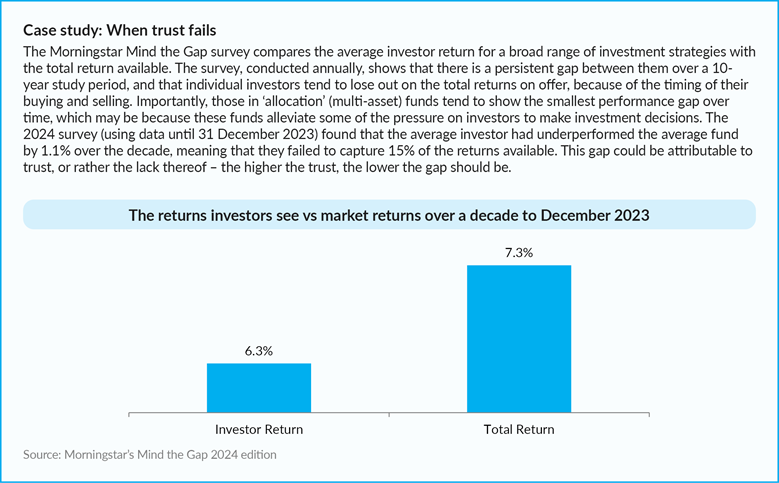
Clear communication and a consistent approach might be part of the antidote that helps keep clients invested, but this requires a clear understanding of the drivers that cause clients to exit early.
Modern investing is plagued by myopia. Daily portfolio updates, quarterly earnings calls, and ‘Best and Worst Funds of the Year’ news articles feed a fixation on immediacy. Yet wealth is built in decades, not days.
So, how can we grow and establish trust in a way that increases the likelihood of positive long-term outcomes?
Part 3: How can we grow trust for positive outcomes?
Trust is not built on glossy brochures, expensive marketing budgets or short-term performance league tables. In many ways, it is hard to pin down and has an intangible component. A good place to start though, is to think about alignment, humility, demonstrated skill, and consistently prioritising long-term outcomes over short-term gratification.
Alignment: Eating our own cooking
A fund manager’s incentives must mirror the client’s. Too often, the industry prioritises asset-gathering fees or short-term performance bonuses, creating misaligned motives. At PSG, alignment begins with a simple question: Would we invest our own capital here?
When portfolio managers have personal wealth in the strategies they oversee, interests converge. This ‘skin in the game’ ethos ensures that decisions prioritise durability over desperation. For example, during the 2020 market panic, our team held positions in high-conviction, undervalued assets and resisted the temptation to pivot, because we were equally exposed to the outcome and could see the long-term potential. Alignment turns abstract risk into shared stakes.
Humility
Admitting errors and evaluating our views regularly and with an open mind, is as vital as conviction. In 2020, we exited an underperforming life insurance company as it became clear that competitive pressure in the company’s core funeral insurance market was escalating dramatically. Another example was consciously exiting an over-leveraged drilling and property company (also in 2020) as operating cash flows dried up and any deleveraging would likely be temporarily or permanently delayed. Sensibly applied, humility protects both capital and our portfolios from the very human tendency towards anchoring and confirmation biases.
Demonstrated skill: Beyond the track record
A track record is a rearview mirror. Skill is the engine. True expertise lies in a repeatable, research-driven process that thrives across market regimes. Consider two managers:
- Manager A delivers 20% returns in a bull market by chasing momentum following ‘what works’, rather than building a long-term investment case based on a fundamental understanding of underlying forces.
- Manager B earns 12% annually by investing in undervalued companies with durable cash flows and after making a careful assessment of intrinsic value.
In a downturn, Manager A’s strategy collapses and their clients are unsure what to expect. Manager B’s process, rooted in fundamentals, persists. Their clients are able to remain patient, knowing exactly what to expect from a manager who is managing their investments using a consistent and repeatable approach, and knowing from experience their patience is likely to be rewarded in the long run.
Our research process combines quantitative rigour with qualitative depth. We visit companies, interview suppliers, and analyse industry tailwinds others sometimes overlook. This ‘boots on the ground’ approach uncovers mispriced opportunities, such as a South African retailer trading at a bargain price in the darkest days of rolling electricity blackouts, or a neglected hotel company with irreplaceable assets during the complete cessation of tourism as a consequence of the Covid-19 pandemic. Knowing what you are good at and doing it consistently should result in good performance, but the impact on building trust with engaged clients is possibly even more important.
Consistency: The antidote to noise
Markets are a distraction machine. Headlines scream about rate hikes, elections or geopolitical shocks, tempting managers to abandon strategy. Yet consistency – not heroics – drives long-term results.
Warren Buffett’s annualised return of 19.8% over the period 1965 to 2023 was not achieved by timing markets. It resulted from unwavering adherence to value investing, even during the dot.com mania when critics labelled him ‘out of touch’. Similarly, our team avoids reactive shifts. During the 2022 market crash, we maintained equity exposure in sectors like energy and mining – areas with visible cash flows and attractive inflation-beating characteristics – while others fled to cash. In times of speculative euphoria and abundant liquidity, we sometimes don’t participate in the most exciting parts of the market (missing out on much of the boom in technology and AI-associated stocks in 2024 was painful!). Consistency is the quiet power of discipline, and we appreciate its value.
Conclusion: Trust is the bridge
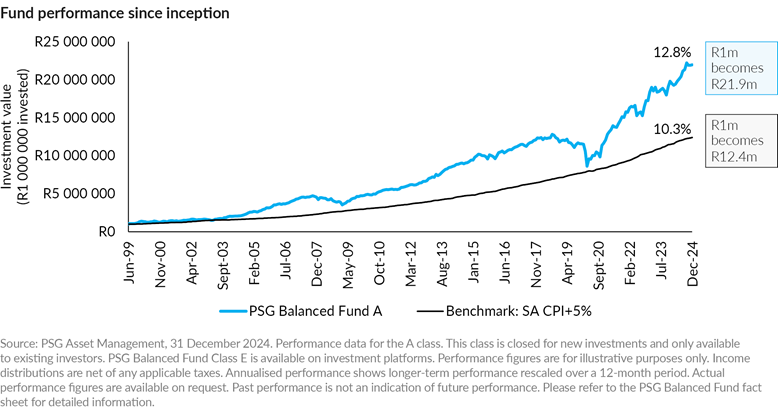
The PSG Balanced Fund’s track record underscores this foundation of trust, delivering a compound return of 12.83% annually since inception. An initial R1 million investment would have grown to over
R21 million – a testament to a disciplined process and enduring partnerships.
In the end, the value we add is measured by the transformation we bring in clients’ lives: our impact needs to be measured on both performance and time horizon dimensions. Trust is the bridge that allows clients to stay the course long enough to reap the full benefit of any partnership.
We aspire to deliver meaningful returns while resolutely seeking to grow the trust that can secure this.

Recommended news
Welcome to the latest edition of the Angles & Perspectives - Q4 2024
In this edition of Angles & Perspectives, we consider the risks and opportunities that others may be overlooking. Head of Research Kevin Cousins highlights the dangers in the US exceptionalism narrative, Chief Investment Officer John Gilchrist explains where we see opportunities for SA growth to deliver surprises, and Head of Equities Justin Floor considers the importance of trust in achieving successful long-term investment outcomes.
Read moreIntroduction - Angles & Perspectives Q4 2024
Read moreThe risks of the US exceptionalism narrative - Angles & Perspectives Q4 2024
Read moreWhere could SA growth surprises originate from? - Angles & Perspectives Q4 2024
Read more
Stay Informed
Sign up for our newsletters and receive information on finance.
