Fraudulent Telegram and WhatsApp groups
Please beware of fraudulent Telegram and WhatsApp groups impersonating PSG Financial Services, our divisions and our advisers. Be cautious, verify links and contact your adviser or Client Services if you have any queries or concerns.
18
November 2025
The hidden risks of hugging an index - Angles & Perspectives Q3 2025

Kevin Cousins, Head of Research
PSG Asset Management

The hidden risks of hugging an index
Indexation and passive investments have become extremely popular over the past few decades. In theory, these strategies offer cost-effective access to markets and an easy way to construct portfolios. However, their efficacy (and continued success) is predicated on a few pivotal assumptions about how markets function. These assumptions may, however, be less foolproof than many investors realise, which has substantial implications for investors’ portfolios, especially in highly concentrated markets.
Indices are ubiquitous in the investment industry
Indices have become ubiquitous in the investment industry. Firstly, active managers use them as benchmarks (typically in their risk models), and secondly, they serve as the basis for passive investing. As such, there is hardly a corner of the investment industry that has remained untouched by the use of indices. However, this also means that their use tends to go largely unquestioned.
Not all market participants are aware that the effectiveness of indexation is predicated on a few key assumptions. John Bogle launched the first retail passive index fund, the Vanguard 500 Index, in 1975. Today, Vanguard’s assets under management (AUM) have grown to US$10 trillion and 50% of total US equity AUM is managed on a passive basis. Passive investing has proved popular because it offers lower fees, good performance and a simple strategy that is easy to understand (and replicate).
However, Bogle frequently highlighted that indexation works for some very specific reasons. To paraphrase him:
- Indexing works because it’s a free ride on the efforts of others. If there were no others, there’d be no free ride.
- The beauty of indexing is that it works because it’s not the dominant strategy. If it ever became the dominant strategy, we’d have problems. (Ref 2)
- If everybody indexed, the only word you can use is chaos, catastrophe… The markets would fail. (Ref 1)
Effective passive management requires a thriving active manager population
Ironically, passive investment needs active management to dominate the price formation process and ensure the market functions as intended. Left to its own devices, cap-weighted indexation is prone to growing imbalances and risks, as momentum tendencies in markets become exaggerated. And it is flows, rather than the existing stock of assets, that determine how markets function. Markets dominated by active manager flows tend to be equilibrium seeking, as these managers buy cheap and sell expensive, pushing stocks towards intrinsic value.
When active manager trades no longer dominate flows (which historically tended to happen only at cycle extremes) markets change character and become deviation amplifying, with higher prices attracting more buying and lower prices more selling. This creates an unstable market, very dependent on continued liquidity flows. Stocks typically end up trading far above any valuation underpin and risk severe declines or crashes when the flow of liquidity slows or reverses.
The chart below by Simplify Asset Management shows an estimate of the change in US equity trading by source. Simplify believes that active management-originated trades declined from some 80% of the total in 1995 to only 10% in 2022.
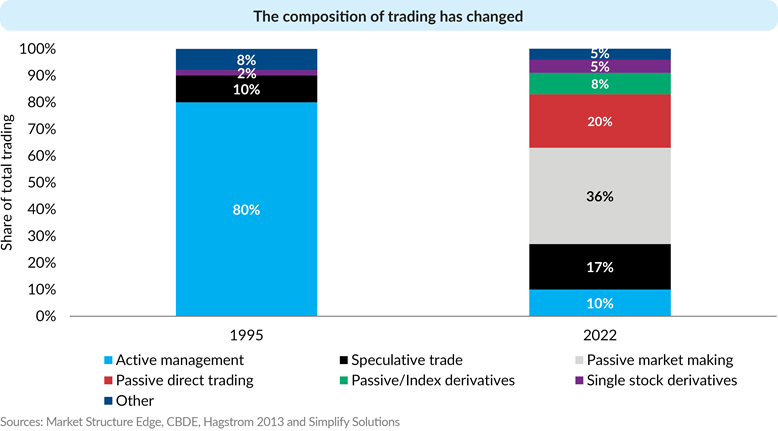
The implication is that periods of deviation amplification have become more prevalent and extended.
Index concentration is now at record levels
Could this be why the S&P 500 and MSCI World Indices are at record levels of concentration? The top 10 companies account for 39% of the S&P 500 Index’s total market capitalisation. Of these, eight companies comprising 35.5% are broadly driven by the artificial intelligence (AI) theme (Nvidia, Microsoft, Apple, Amazon, Alphabet, Meta, Broadcom and Tesla). Over the past few years, the index has become more concentrated than ever. While the MSCI World Index in theory covers 1 320 companies across 23 countries, in practice it is no better than the S&P 500 Index. Its top 10 holdings are essentially the same as those of the S&P 500 Index and comprise 36% of the index, of which also eight companies totalling 33% are AI-themed.
…but why does it matter?
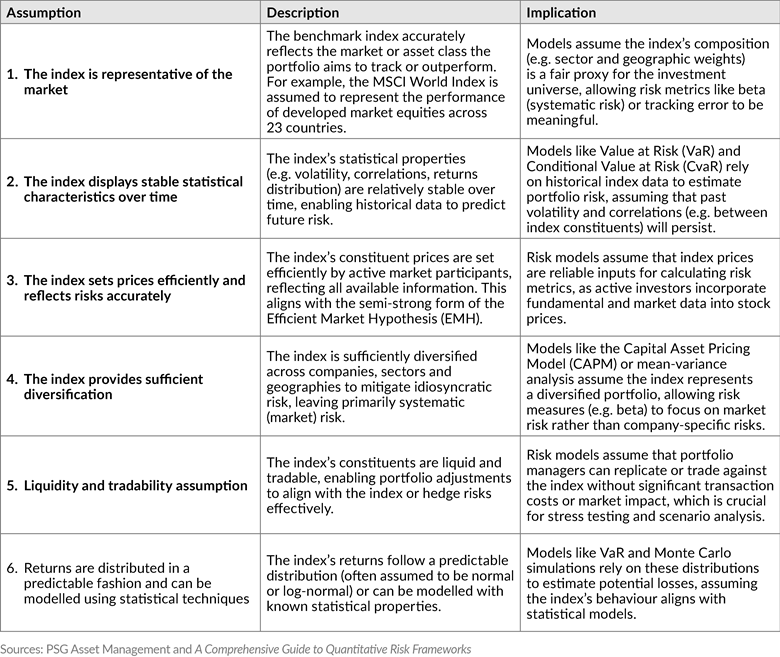
The industry tends to assume indices have certain characteristics that underpin their functionality and suitability for use in various models and risk measures. Given their widespread use, one would hope that investment managers using quantitative risk models understand these embedded assumptions.
Ignore the underlying assumptions at your peril
Investment managers using quantitative risk models need to understand these embedded assumptions, for reasons that will become clear. Retail investors may be surprised to discover that Assumptions 2 and 6 above are clearly not supported by actual market behaviour, meaning some scepticism regarding model outputs has always been important. Remarkably many asset managers (and financial institutions generally) appear to blindly manage to model-derived risk constraints despite this. What has changed now is that the dramatic increase in index concentration to record levels tests the validity of assumptions 1, 3 and 4 as well.
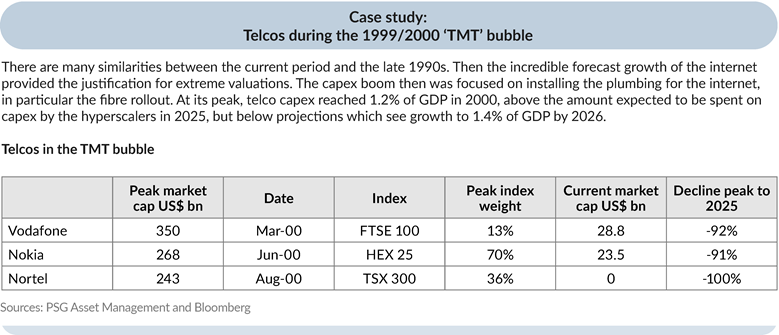
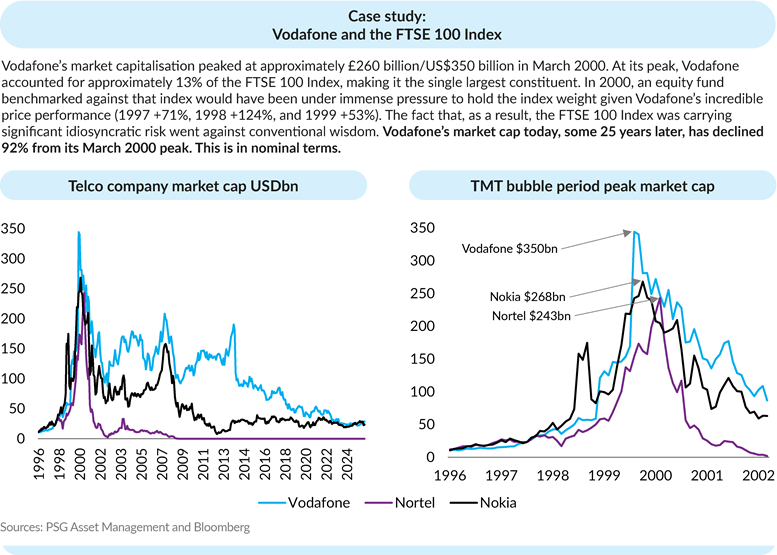
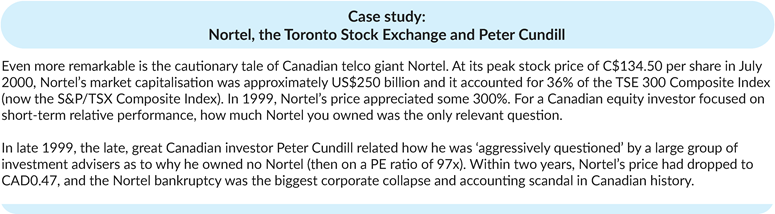
It is fair to say the current levels of index concentration calls into question whether the S&P 500 Index and MSCI World Index are still effective benchmarks. This means passive investors are effectively taking very substantial idiosyncratic risk, and by implication, the output of most quantitative risk models using these benchmarks should at the very least be viewed with a common-sense overlay. The importance of this will be highlighted by our case study below, which focuses on a previous occasion when benchmark indices became overly concentrated.

How should investors respond?
Indices, as it turns out, are not infallible instruments, and hugging an index is not risk free. If your global equity investments are dominated by passive funds and ‘benchmark-hugging’ active mandates, consider looking for some true differentiation, e.g. products based on equal weight or fundamental indices, or active managers that are not as benchmark focused.
As a bottom-up stock picker, PSG Asset Management constructs its global equity portfolios primarily based on its best stock ideas, which are not driven by index weights. The result has been funds that have provided good diversification benefits historically, and we believe this will continue in the years ahead.
References:
- John Bogle interview with Morningstar (2006), cited in Money Smart Guides (2021)
- The Little Book of Common Sense Investing, 2007
- The Life of Peter Cundill, Christopher Risso-Gill
- A Comprehensive Guide to Quantitative Risk Frameworks, metricstream.com

Recommended news
Welcome to the latest edition of the Angles & Perspectives - Q3 2025
In this edition, we consider what lies ahead after a strong run in equity markets and given rising levels of market concentration. Head of Research Kevin Cousins highlights the hidden risks in hugging an index. Fund Managers Shaun le Roux and Mikhail Motala unpack the drivers behind the equity rally, and share where they are currently finding opportunities locally. Finally, Fund Manager Philipp Wӧrz and Deputy Chief Investment Officer Greg Hopkins turn their focus to global markets, and explain the value of our differentiated approach.
Read moreIntroduction - Angles & Perspectives Q3 2025
Read moreCan equity markets continue their strong run? - Angles & Perspectives Q3 2025
Read moreOpportunities unseen: finding what others have missed - Angles & Perspectives Q3 2025
Read more
Stay Informed
Sign up for our newsletters and receive information on finance.
