Fraudulent Telegram and WhatsApp groups
Please beware of fraudulent Telegram and WhatsApp groups impersonating PSG Financial Services, our divisions and our advisers. Be cautious, verify links and contact your adviser or Client Services if you have any queries or concerns.
04
February 2026
Markets, headlines, and the cost of panic

Patrick Duggan
PSG Wealth
Something deep in human nature makes us lean in when we hear whispers of danger on the horizon.

Feel free to reach out to PSG Wealth Manager Patrick Duggan directly.
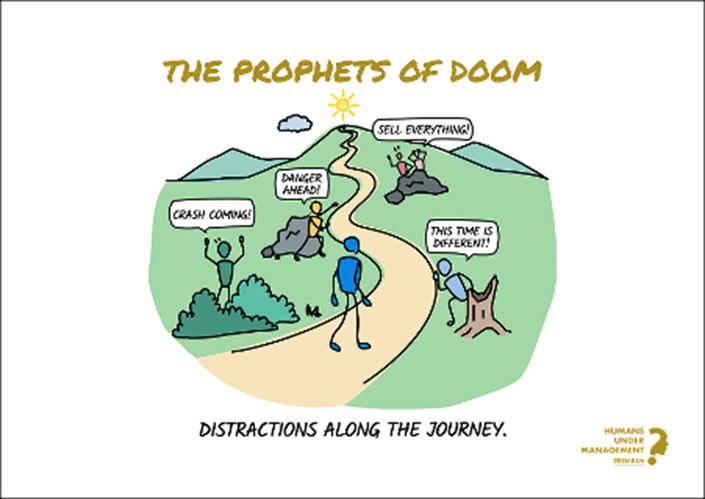
Throughout history, prophets of doom have commanded our attention, warning of catastrophes only they could foresee. In our age, these prophets have traded robes for business suits, swapping predictions of divine wrath for forecasts of market collapse. Their stages are now financial networks, their scrolls replaced by charts, but their message remains unchanged: devastation approaches, and only they saw it coming.
After three years of solid market returns, they're back with familiar predictions. The same faces, the same warnings, year after year. Market history is filled with predictions that didn't materialise as forecasted, yet somehow, we still find ourselves drawn to listen.
Perhaps you've felt it yourself, that flutter of anxiety when a confident expert declares the party is over. Unfortunately, when predictions don't pan out, we forget. When they occasionally align with reality, that single success becomes legendary. And so, the cycle continues, with each new market high bringing fresh warnings of imminent collapse.
The tale of Chicken Little (Market Edition)
One calm, ordinary day, Chicken Little was pecking around, minding his own business – just as the markets were ticking along as they usually do.
Suddenly, an acorn fell on his head.
Certain it was a sign of financial doom, Chicken Little ran through the barnyard shouting:
“A crash is coming! The sky is falling! Sell everything!”
And just like in today’s markets, the other animals listened.
Henny Penny stopped contributing to her investments.
Ducky Lucky sold off at a loss “to be safe”.
Turkey Lurkey switched his long-term plan for a hot new trading strategy.
And together, they all followed Chicken Little in a panic-driven march toward “safety”.
On their way, they met Foxy Loxy, who welcomed them warmly offering emotional comfort and bold predictions.
Foxy Loxy, of course, represented those who benefit from fear:
- sensational media,
- products promising protection at a cost,
- and commentators who grow more famous every time they successfully scare people.
The end of the original story is not pretty.
The moral? Acting on fear leads you straight into the jaws of poor decisions.
What Chicken Little missed?
Acorns fall all the time. So do markets – corrections, pullbacks, volatility. They are normal.
But Chicken Little made three classic errors:
- He mistook noise for signal: Not every headline, indicator, or chart pattern predicts catastrophe.
- He reacted emotionally instead of rationally: Fear may keep you alive in nature – but it destroys long-term returns.
- He convinced others to abandon their plans: The crowd often amplifies fear.
Why doom sells (and why we buy it)
Our ancestors survived by overreacting to threats. Missing one danger could be fatal. Missing one opportunity just meant waiting for another. But times have changed. Our portfolios don't face sabre-toothed tigers, and market volatility isn't a survival threat; it’s a normal feature of financial markets.
Perhaps the problem is that pessimism sounds protective, and optimism sounds like a sales pitch. The prophets position themselves as our caring protectors, so why wouldn’t we listen?
The warning about AI bubbles today sounds remarkably similar to those who warned about the internet bubble in the 1990s. They were "right" eventually, but investors who listened missed years of extraordinary gains before the correction finally came and were scared out of owning great companies that are still around today.
Corrections of 10-20% occur regularly, so we understand that markets will decline again. The real risk of the forecasts is the certainty with which these prophets claim to know exactly when and by how much.
Yet despite all we know about how markets behave; each new wave of warnings still finds an audience. History repeats itself, not through the events, but through our reactions to them.
But what about actual market crashes?
Here is the truth no one shouting online likes to say:
- Real crashes are extremely difficult to predict, especially the timing.
- Even economists, central banks, hedge fund managers, and quant models get it wrong.
- We know crashes will happen.
- We just do not know when or what the catalyst will be.
- Which means trying to dodge them usually causes more damage than staying invested.
- Historically, missing just a few of the best market days – often clustered right after the worst days – dramatically reduced long-term returns.
The real cost of listening
Even when warnings about a downturn contain some truth, reacting to them can still do more harm than good. Investors who change course at the first sign of trouble often upset a carefully designed portfolio, lock in losses, and miss the subsequent recovery.
Markets move in cycles, but those cycles rarely unfold in a straight line. Trying to sidestep every decline usually means mistiming both the fall and the rebound.
The greater danger lies in breaking the long-term discipline that successful investing requires. A single reaction, made in fear or overconfidence, can undo years of steady progress. Rebuilding that confidence and structure later is far harder than holding it through a temporary decline.
Those who try to outguess events are left chasing the next move, always reacting instead of progressing. But financial markets reward patience and planning, not prediction. Every decision to stay the course, to rebalance rather than retreat, and to trust a sound process instead of a headline, strengthens the foundation for lasting wealth.
The winning strategy? Do not be Chicken Little
Instead of reacting to falling acorns, we follow a different playbook:
- Stick to a long-term plan grounded in your goals, not headlines.
- Stay diversified and disciplined.
- Focus on what you can control.
- Accept that volatility is not a bug; it is a feature.
- Let the markets reward patience.
Final thought: Ignore the acorns
The next time someone says, “The sky is falling,” remember this:
- They may sound confident.
- They may use charts, data, and compelling narratives.
- They may even believe what they are saying.
- But fear is not a strategy.
A disciplined plan – reviewed, monitored, and tailored to your goals – is.
Turning fear into focus
The next time you come across a confident prediction of an impending crisis, pause and remember not everyone in the financial world is playing the same game. The commentators on television, the traders chasing short-term moves, and the long-term investor building wealth over decades each have different goals. What feels urgent to them is often utterly irrelevant to you.
Your game unfolds over years and decades, not weeks. The purpose of your plan is not to predict what happens next, but to guide decisions that create security and freedom over time. That perspective lets you filter information instead of reacting to it.
When the next prophecy of doom appears, let it sharpen your focus rather than feed your fear. Remember what truly matters: a sound plan, steady saving, and patience through market cycles. Those are the real defences against uncertainty.
If you ever feel unsettled by the noise, please reach out.
We are here to help you focus on the bigger picture… not falling acorns.
Reminder
Reminder to leverage tax incentives before the tax year-end.
“You must pay taxes. But there’s no law that says you gotta leave a tip” - Morgan Stanley advertisement
Two of the best ways to save and invest (and preserve purchasing power) tax efficiently are via a pre-retirement vehicle such as a retirement annuity (RA) or a voluntary investment vehicle such as a tax-free investment plan (TFIP). See: Don’t downgrade your goals. Upgrade the way you save for them.
NB: You have until 28 February 2026 to maximise your tax incentives before the tax year-end.
Contact your Wealth Manager as soon as possible to discuss your unique investment needs.


Stay Informed
Sign up for our newsletters and receive information on finance.
