Fraudulent Telegram and WhatsApp groups
Please beware of fraudulent Telegram and WhatsApp groups impersonating PSG Financial Services, our divisions and our advisers. Be cautious, verify links and contact your adviser or Client Services if you have any queries or concerns.
08
January 2026
How to invest when all the “gurus” are calling tops

Schalk Louw, Wealth Manager
Wealth
They say that even a broken clock is 100% correct twice a day. And if you’ve been following investment news lately, you’ll know that investment gurus will also, at some point, be 100% correct with their predictions of a market correction. When exactly they will be right is something only time will tell. This brings us to the real question: What should you do while we wait for those predictions to become true? Should you simply stay out of the market altogether?

Feel free to reach out to PSG Wealth Manager Schalk Louw directly.
Before answering that, we should look at the psychology behind such a decision.
In a 2008 research report written by Geir Jordet and Esther Hartman, titled “Avoidance Motivation and Choking Under Pressure in Soccer Penalty Shootouts”, they analysed every penalty shoot-out ever held in the World Cup, European Championship and UEFA Champions League. In total, that was 36 shoot-outs, or more specifically, 359 kicks. The findings were fascinating.
For the kicks where the player could instantly win the match with that specific kick, the success rate was 92%. For the kicks where a miss would immediately eliminate the team, the success rate dropped to only 62%.
What does this tell us? When players acted with the intention to win, they succeeded 92% of the time. When players acted mainly to avoid losing, their success rate dropped to 62%.
Back to my original question: To avoid losing, should I now stay out of the market altogether?
Here, I will use the FTSE/JSE All Share Index (JSE) as an example, since so many “gurus” over the years have repeatedly warned investors about losing money by investing in the JSE. Like all stock markets around the world, the JSE has experienced both good times and bad times. That is the nature of growth investing.
Since the beginning of 1998, the JSE has fallen by at least 20% from its highs four times, with three of those four drops exceeding a quarter (25%) of its value. During these almost 28 years, we experienced events such as the 1998 Russian financial crisis, the dot-com bubble, the 9/11 attacks, the wars in Afghanistan and Iraq, the 2008 global financial crisis, followed by the world recession, and more recently COVID-19, as well as the wars in Russia-Ukraine and Israel. Reading this alone could scare any potential investor into trying to avoid losing money rather than focusing on long-term winning.
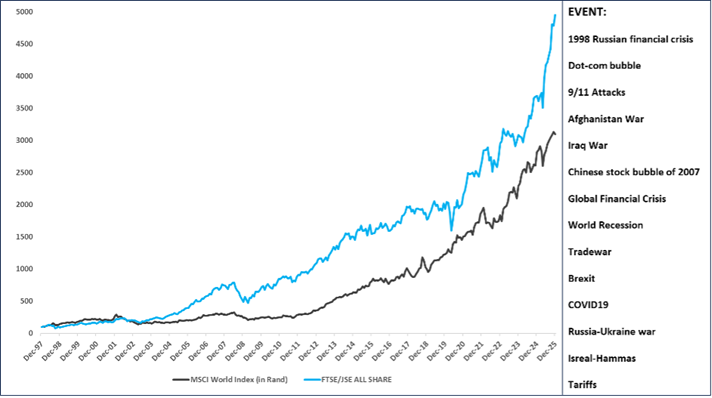
Graph: FTSE/JSE All share versus MSCI World Index in rand with market shocks (Source: Refinitiv)
And yet, over these almost 28 years (since early 1998), the JSE has grown by 15% per year, which was nearly three times the rate of inflation over the same period.
At the beginning of 1998, global markets had also run hard for the previous two years, and most “gurus” warned about overheated market conditions. If, on the back of that, you had decided to rather invest in money market instruments for the next 28 years in an attempt "not to lose," your total returns (before tax) would have been only 43% of the JSE’s return. Of course, I know that nobody would realistically hide in money market funds for 28 years. And with hindsight being perfect, we all think we would have spotted the lows after each decline. But in my more than 30 years in the market, I have yet to meet anyone who gets the tops and bottoms 100% correct.
Let’s take this one step further.
Let’s say you were the unluckiest person who invested right before the JSE dropped 20% or more during these past 28 years. You would likely not have enjoyed the short-term experience very much. But here is the big “but”: your annual returns up to today (30 November 2025) would still have looked as follows for all four of these historical corrections:
- 1998 = 14%
- 2002 = 14%
- 2008 = 11%
- 2020 = 14%
For those who invested to win, rather than to avoid losing, even investing at the worst possible times in a market that many “gurus” labelled as one to avoid, would still have comfortably outperformed both inflation and money market returns up to today.
I am not saying that everyone should rush out and invest in the JSE now. You should always invest according to your personal risk tolerance, something your financial adviser is best equipped to help you with. But be very careful, like many are doing now by calling market tops, not to invest simply to avoid losing, when your real focus should be long-term investing to win.


Stay Informed
Sign up for our newsletters and receive information on finance.
