Fraudulent Telegram and WhatsApp groups
Please beware of fraudulent Telegram and WhatsApp groups impersonating PSG Financial Services, our divisions and our advisers. Be cautious, verify links and contact your adviser or Client Services if you have any queries or concerns.
25
June 2024
Concentration Risk within S&P500

Schalk Louw, Wealth Manager
Wealth
I want to start this month's newsletter with a little story. There once was a quaint little village nestled in the mountains where most families earned their living through a single apple orchard that thrived for generations. The apples were renowned for their quality and provided a steady income. However, blight unexpectedly swept through the orchard one year, decimating the trees and destroying the harvest. With no other industries or crops to rely on, the entire community suddenly faced economic hardship. These hypothetical circumstances represent concentration risk: relying solely on apple farming left the village vulnerable to agricultural disasters, jeopardising their livelihoods and financial stability.

Feel free to reach out to PSG Wealth Manager Schalk Louw directly.
Another unfortunate fact of this story is that any person in or even outside this village would find it extremely difficult to invest newly earned capital anywhere but in this apple orchard because it was all they had to offer. Some readers might stop me at this point, pointing out that it was clear as day that this community was taking enormous risks by concentrating all their focus and investments solely on this village's apple orchard. But those are the facts of this story. These issues always become more apparent in hindsight because if we lived there during that time, it would have been so easy to argue that this village's apples could monopolise the market. However, that's where the word "unexpected" becomes crucial in any investment. Most of the major corrections in history have been caused by unexpected events.
To be clear, I am not pretending to be Nostradamus or a fortune teller, and I cannot predict when or how the next unexpected event will occur. What I will do is shed some light on what concentration risk might look like and what can be done to diversify this risk.
"I would like to invest offshore”
This is a request that I, as a wealth manager, deal with frequently. First and foremost, I want to emphasise that while I am optimistic about South Africa's recovery and future growth prospects, South Africa's Gross Domestic Product (GDP) represents only 0.34% of the world economy, according to the latest World Economic Outlook by the International Monetary Fund (IMF). Therefore, keeping 100% of your capital in South Africa would not only lead to concentration risk but would also, in my opinion, be an emotional decision, as I have discussed at length previously.
The issue is that the perception of "offshore" has become somewhat distorted. The fortunate, or perhaps even unfortunate, reality is that the world has become so fond of US "apples" that this has caused a new concentration risk. I believe the second most popular index for investors is investments in an MSCI World Index or fund. I will later delve into why I rank this as the second most popular investment in this report.
The above-mentioned IMF report places the world's largest economy, the USA, at 26.3% of the total World GDP. Without attempting a direct comparison (the index only has exposure to developed countries), it's interesting to see how much investment attention this US "apple orchard" has captured over the past decade and a half. Let's consider the weight of the USA in the MSCI World Index in September 2011 as an example. Even then, it made up 54% of the total index. This weight grew to over 63% early in 2020 for many good reasons and providing good returns. Today (20 June 2024), the weight of the USA within the MSCI World Index stands at a whopping 72%. The USA has undoubtedly performed very well over the past decade. However, the problem remains: what happens if something unexpected happens in the USA? It is certainly no longer cheaply priced. And their economic challenges are becoming more evident daily.
The Three Musketeers
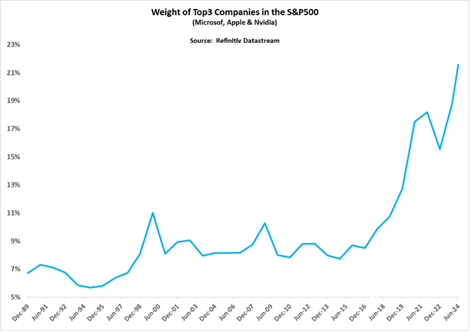
In getting back to what I currently consider to be the most popular investments, not only in South Africa but worldwide, the S&P 500 Index has to be number one. Before I elaborate, just a brief bit of history. At the turn of the millennium (1 January 2000), Microsoft, General Electric and Cisco Systems were the three largest stocks (by market cap) in the S&P 500 Index. These three stocks alone accounted for more than 11% of the entire index. Not unlike now, the US "apple orchard" was the top investment destination, and investors at the time couldn't find any reason to worry about concentration risk. Then, the unexpected happened. Growth didn't materialise as expected and the stock prices of these three companies plummeted over the following two years: Microsoft fell by 56%, General Electric by 53% and Cisco Systems by 76%.
Fast forward by just over 24 years, and once again, we find ourselves in a situation where the strength of the S&P 500 hinges on a few key components. Today, three stocks, Microsoft (again), Apple and Nvidia collectively comprise a staggering 22% of the S&P 500 Index.
Weight of the top three largest companies (Microsoft, Apple & Nvidia) in the S&P 500 Index
Source: Datastream
To put this into perspective, if you currently have an investment in the MSCI World Index (through an ETF, for example), 72% is essentially invested in the S&P 500, with 22% of that 72% exposed to just three stocks. This means that nearly 16% of your foreign investments (which should provide exposure to the entire world) are concentrated in just three stocks.
In my opinion, the solution is much simpler than the problem itself. Start by expecting the unexpected and properly diversifying your investments. Refrain from assuming that you are adequately diversified because your investments are labelled as foreign. Consult with a financial adviser who will not only consider historical returns and the costs of your investments but also perform a proper risk analysis.


Stay Informed
Sign up for our newsletters and receive information on finance.
