Fraudulent Telegram and WhatsApp groups
Please beware of fraudulent Telegram and WhatsApp groups impersonating PSG Financial Services, our divisions and our advisers. Be cautious, verify links and contact your adviser or Client Services if you have any queries or concerns.
17
September 2021
Is the reward worth the risk?

Schalk Louw, Wealth Manager
Wealth
I have discussed the concept of danger pay on a few previous occasions. Basically, this term was mostly associated with soldiers that were required to work in very dangerous areas. These days it can even include special types of insurance benefits against events like kidnapping for families whose occupations require them to relocate to areas where the risk of kidnapping is high. Whatever the package entails, in essence it refers to extra benefits or compensation for people who are risking their lives to work in dangerous places, amongst other things.

“ If investors had a way of knowing that shares would outperform the money market over the next year, then things would have been much easier. ”
Many individuals find these benefits extremely attractive, but it’s crucially important that whoever considers them is well aware of the associated dangers. In most cases, workers have to be willing to pay with their lives in exchange for a few extra thousand rand per month.
In the investment world, we are also familiar with danger pay, better known as risk premium. Although it won’t necessarily claim your life, it’s definitely something you should be aware of at all times, especially when it comes to constructing your personal investment portfolio.
Just briefly, risk premium refers to the percentage by which, for example, shares must outperform risk-free investments in order to make it worthwhile for investors to ‘operate’ in more dangerous territory. Many reports detailing several different methods to calculate risk premium have been released over the years, but I have found that many of them are just way too technical. I find that the simplest way to calculate risk premium is to look at the difference in annual returns between shares and money market rates respectively.
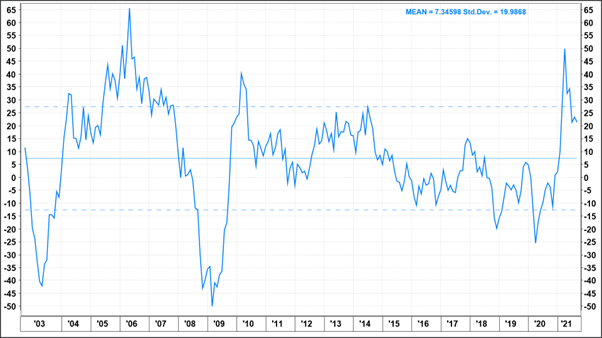
Graph 1: FTSE/JSE All Share Index % minus money market %
source: Iress
Investors would have earned 7.3% more, had they been invested in shares over the past 20 odd years (including dividends, but excluding taxes) than they would have earned if they had invested in the virtually risk-free money market. This means that investors require companies’ expected earnings to yield at least 7% more than risk-free rates to make the risk worth the reward.
Graph 1 shows us that investors had a tough time during the 5-year period between 2015 and 2020, with this risk premium almost never reached over any rolling 12-month period. Even the current 20%-plus outperformance must be placed in context, as share prices came from very low levels 12 months ago. In short, it was definitely a rough six-year period for investors.
What should we do now? If investors had a way of knowing that shares would outperform the money market over the next year, then things would have been much easier. But no one can make such predictions with any certainty, so the best tool to our disposal is South African analysts’ general growth forecasts for South African companies.
Thomson Reuters’ (source: Refinitiv) consensus forecasts give us a very good indication of analysts’ expectations for growth in shares. When we look at their forecasts for the growth of individual shares in the FTSE/JSE All Share Index, we will see that their expected weighted average growth now stands at a whopping 28.2% for the next 12 months. With money market rates currently trading at around 4%, it means that to make higher-risk investments such as shares a worthwhile option for investors, they must grow by at least 11% per year. If these analysts are correct, local shares should deliver about 24% more growth (excluding taxes) than money market rates over the next 12 months. Even if a small interest rate hike was to occur in South Africa within the next 12 months, the expected risk premium still looks very attractive.
That said, I still believe that investors should approach the stock market with extreme caution. Yes, the expected danger pay may look much more attractive now, but we are definitely not out of the warzone just yet.

Stay Informed
Sign up for our newsletters and receive information on finance.
