Fraudulent Telegram and WhatsApp groups
Please beware of fraudulent Telegram and WhatsApp groups impersonating PSG Financial Services, our divisions and our advisers. Be cautious, verify links and contact your adviser or Client Services if you have any queries or concerns.
13
April 2021
Time to set up your risk-proof budget
Jan van der Merwe, Head of Actuarial and Product
PSG Wealth
Finance minister Tito Mboweni delivered an optimistic budget speech on 24 February 2021. The budget speech detailed initiatives that should decrease the tax burden on many citizens.

“ You need to start by making incremental changes to your lifestyle and to continue increasing your commitment until you attain your optimal savings level ”
Tax savings
The personal income tax brackets have increased by 5%, which is more than inflation. This will provide R2.2 billion in tax relief. Most of that relief will reduce the tax burden on the lower and middle-income households.
Table 1 shows the annual savings in tax compared to the previous year for different age groups and income categories.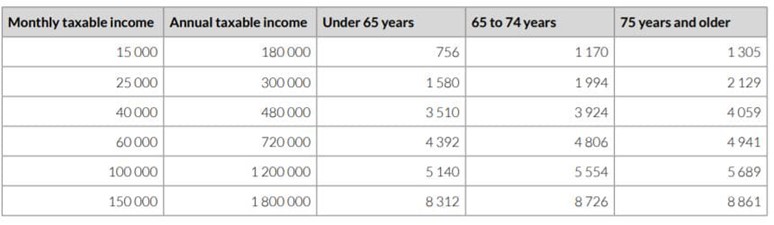
The importance of saving for a rainy day
Although the tax amounts saved would be relatively small, they still provide some degree of relief for taxpayers, and you might already be thinking about how you are going to spend that extra cash. However, if the past year has taught us nothing else, it is the importance of financially preparing for uncertain events. Whether it's uninsured medical expenses, unplanned car or home repairs, or an unexpected loss of income, budgeting for a rainy day is crucial.
Important factors to consider when setting up your emergency fund:
- The savings should be easily accessible.
- Ideally, the returns should at least keep pace with inflation.
- Having a budget and sticking to it will help you to set aside enough savings for a rainy day.
Saving and Budgets 101
The rule of thumb for saving is to allocate at least 15% of your pre-tax income to retirement savings. After you have done this, you can then consider the following spending guidelines for your after-tax income:
- 60% for necessities (housing, food and utilities)
- 30% for discretionary items (entertainment and luxuries)
- 10% into discretionary savings (education, emergency fund, holidays etc.)
Everyone has unique financial needs, so you need to determine the formula that is right for you. Be sure to talk to a financial adviser to find the right savings plan for you.
A few practical tips to help you save more
Delaying saving until you have ‘enough’ money is sure to end in failure to meet your savings goals. You are far more likely to succeed if you prioritise investment and commit your money to your goals before you spend it on the next ‘online shopping special offer’ that comes your way.
You need to start by making incremental changes to your lifestyle and to continue increasing your commitment until you attain your optimal savings level. Over time, such small adjustments are unlikely to be noticed, but the ‘sacrifices’ you are making gradually and consistently add up. The key is to start as soon as possible, and to continue to build on that once you have a firm foundation in place. Here are few more guidelines to get you started:
- Adjust the amounts you save annually in line with inflation increases.
- Keep a record of all the money you spend and compare it to your budget each month. This will help to
- point out where you need to make some adjustments to your spending.
- Don’t try and keep up with the Joneses.
- Always preserve your retirement savings when you change employment.
Useful products for a rainy-day fund
With a focus on saving for a rainy day, below are some key highlights of products that you can utilise.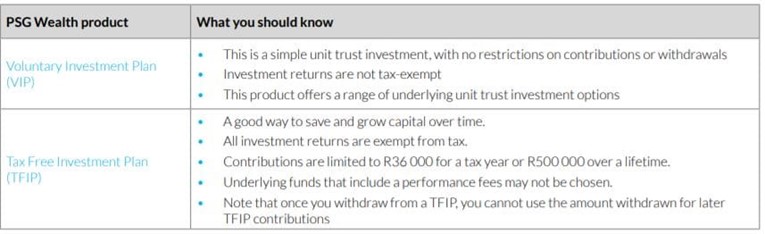
Selecting underlying funds
A key aspect to saving is the selection of the underlying funds within the product. Fund selection will depend on your goals, approach to risk and time horizon for investing. When saving for a rainy-day fund, capital preservation should be a focus. Investments that provide some exposure to growth assets, while protecting downside fluctuation, are therefore likely to be most suitable.
Make sure that you consult with your financial adviser to determine the level of risk that is suitable for you before deciding which products are suitable. Determining your risk profile will also be vital in determining what potential events might occur in the future and which investments can protect you from the financial consequences of such events.
Recommended news

Welcome to the latest edition of the Wealth Perspective
After a year in which unemployment reached an all-time high of 30.8%, and the economy contracted by an estimated 7.2%, many investors are understandably anxious about the low growth environment and current volatility. The Covid-19 pandemic has affected our communities in almost every aspect of our lives, and from an investment perspective it has caused massive disruption to the world’s financial markets. Within this turbulence, for many people it is the risk, rather than the return on their investments, that has been front of mind.
Read more
Employee Benefits Insight: How to deal with longevity risk
Longevity risk is one of the biggest risks facing retirees. Recent research has been highlighting how life expectancy of individuals is increasing. What does that mean and how can this affect your retirement savings?
Read more
Fixed Income Investors Can Benefit from South Africa’s Distorted And Steep Yield Curve
A distorted yield curve offers investors access to potentially equity-like returns Fixed income markets have been through a tumultuous year. The rate cuts associated with efforts to contain the economic fall-out of the Covid-19 pandemic, together with worries about South Africa’s fiscal position and investor preference for low risk options, have driven distortions in the local yield curve.
Read more
Stay Informed
Sign up for our newsletters and receive information on finance.
