Fraudulent Telegram and WhatsApp groups
Please beware of fraudulent Telegram and WhatsApp groups impersonating PSG Financial Services, our divisions and our advisers. Be cautious, verify links and contact your adviser or Client Services if you have any queries or concerns.
07
December 2022
Saving for retirement during market downturns

Adriaan Pask, Chief Investment Officer
PSG Wealth
It’s easy to understand why the failure to achieve expected returns on investments can be frustrating for investors. Although this sense of failure and frustration can be felt throughout all market cycles, it is often felt more deeply during bear markets, or when market volatility is as high as it is currently.

“ Be fearful when others are greedy, and greedy when others are fearful. – Warren Buffet ”
What has been driving volatility and market pressure?
Higher interest rates due to inflation
2022 has been a volatile year for markets. Financial conditions have tightened as policymakers continue to increase interest rates in an effort to bring down decade-high inflation. As a result, asset classes have sold off significantly to date.
Hopes of an early policy pivot were countered at this year’s Jackson Hole Economic Symposium where the US Federal Reserve (Fed) reaffirmed its commitment to fighting inflation, despite the inherent risks to the growth outlook, which caused global equities to fall nearly 7% in the second half of the third quarter. In the year to date, this asset class (as measured by the MSCI All Country World Stock Market Index) is down 25.70%, amid a slowing growth backdrop.
Government bond yields were generally higher over the quarter, weighing heavily on market returns. The FTSE World Government Bond Index registered a negative return of 7.61% for the quarter ending 30 September 2022, and a decline of more than 20% year to date. Credit spreads widened amid fears of a tougher economic environment and underperformed their government peers over the same period.
Global property was not spared from the aggressive rout, with the S&P Global Property Index plunging 11.63% in 3Q22 and 28.72% year to date. Out of all asset classes, only cash and commodities have managed to post gains.
Chinese property woes
Asian markets also felt the brunt of the third quarter after the assassination of Abe Shinzo, the former Prime Minister of Japan, while China continued to deal with geopolitical tensions with Taiwan and a property crisis that shows no sign of abating. China’s property sector has struggled since regulators clamped down on excessive borrowing in 2020. The crisis further deepened after Evergrande – the country’s largest property developer – defaulted on bond payments in 2021, crippling construction and instigating mortgage boycotts from disgruntled homebuyers. Demand in the sector is yet to recover, with a decline in developer sales highlighting the gloomy outlook. All this uncertainty has reinforced the risk-off sentiment that firmed in the second quarter of the year, which has led to the US dollar rising to its strongest level in two decades.
Russia’s invasion of Ukraine
24 November 2022 marked nine months since Russia launched a full-scale invasion on Ukraine, and with no end in sight, Russia is set to continue its military objectives in key strategic areas in Ukraine. According to the Organisation for Economic Cooperation and Development (OECD), the drawn-out conflict is expected to cost the global economy a total of US$2.8 trillion (almost the value of the entire UK economy) in lost output by the end of 2023. This is over and above Ukrainian President Volodymyr Zelenskiy’s estimate of around US$55 billion that is needed to narrow 2023’s anticipated budget deficit and a further US$17 billion to rebuild key infrastructure. Analysts warn that Ukraine’s need for financial support could easily spill over to 2024 and beyond.
UK political turmoil
This year has seen Boris Johnson tender his resignation as British Prime Minister and leader of the Conservative Party against a series of ethics scandals, with Liz Truss being elected as his successor in September, before resigning a mere six weeks later and being succeeded by Rishi Sunak. Truss’s resignation came after her radical economic growth plan was criticised. Although the proposed tax cuts that were part of her growth plan have since been renounced, the proposal spurred panic and market volatility that weakened the pound. The incumbent prime minister has since restored the ban on fracking in England and forged ahead with a cabinet reshuffle that not all opposition parties are pleased with.
While you may not be able to control market behaviour, you do have control over other variables in the wealth equation
In previous publications, we have highlighted that the amount of wealth an investor creates over time is largely a factor of three key drivers: investment performance, contribution size, and contribution frequency – which I like to refer to as the wealth equation variables – but what happens if one of these variables is under pressure?
The approach here is to pull the different levers that are at your disposal. For example, increasing the frequency of your contributions and the amount you save gives your investment a fighting chance – even when markets experience turbulence from time to time. Without realising it, investors actually have more control over their wealth creation journey than they think. Aside from choosing an investment that gives you a return for your specified goal, you are in control of when you start to invest and how much you contribute. Be that as it may, I do think that investors should never let a good downturn go to waste because, when markets are as volatile as they are currently, it is often the best time to invest. This is usually because asset prices are under pressure and investors can buy into the market at attractive levels.
“Be fearful when others are greedy, and greedy when others are fearful.” – Warren Buffet
If you are not getting the expected market returns, how much do you need to contribute to still reach your investment goals?
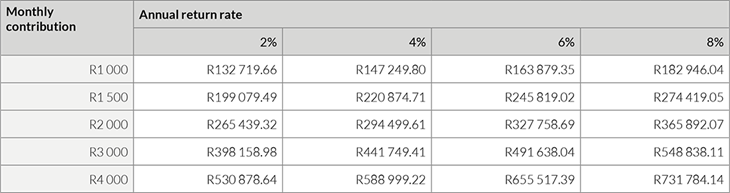
The table below provides an example of how investors can ensure they still make their expected return by increasing their monthly contribution – especially during periods when the markets are volatile and do not perform as they may have expected.
For example, if an investor contributes R1 000 per month, and expects their portfolio to deliver 8% per annum (p.a.) but market volatility causes their portfolio to only deliver 2% p.a., then the investor needs to increase their monthly contribution by approximately R500 a month to ensure they get a similar return. By contributing R1 500 a month instead of R1 000, an investor can accumulate almost R200 000 after a decade with an investment portfolio that delivers a 2% annualised return. Contributing more every month, this investor actually generates more wealth than the investor contributing R1 000 a month with an investment portfolio that delivers 8% p.a.
As expected, the data also shows that the most powerful impact is when the investment portfolio generates its maximum intended annual return, and the investor contributes as much as possible every month. This is the ideal scenario where both the contribution and portfolio returns are high, but in reality, this is not always possible. The best way to sustain investment growth is to increase your contributions when markets are struggling. This is also a sound investment approach, as you increase contributions when markets are weak and in doing so, you take advantage of lower prices, which ultimately puts you in a strong position for when markets recover again.
How the value of the investment changes after 10 years if you increase your monthly contribution
Source: PSG Wealth research team
Focus on what you can control
It takes discipline to increase your investment when markets are volatile, but remember, this is one part of the wealth creation equation that is entirely in your control. Long-term investment success is not just about market returns. Investors must recognise that investment contribution size and frequency are critical components in the wealth creation equation. When markets are as volatile as they have been, recognise this as an opportunity to enter markets at lower levels. Markets may be volatile over the short term, but over the longer term they recover. Investors should shift their focus from worrying about markets, to understanding they still have control over their financial destinies, by simply recognising the importance of their own savings strategy.

Stay Informed
Sign up for our newsletters and receive information on finance.
