Fraudulent Telegram and WhatsApp groups
Please beware of fraudulent Telegram and WhatsApp groups impersonating PSG Financial Services, our divisions and our advisers. Be cautious, verify links and contact your adviser or Client Services if you have any queries or concerns.
07
December 2022
Retirement Annuities and Tax-Free Savings Accounts: gaining maximum benefits before the end of the tax season

Jan van der Merwe, Head of Actuarial and Product
PSG Wealth
As the year draws to a close, many will be looking forward to a well-deserved break. Although it will be a time to relax and hopefully set aside financial concerns for a while, keep in mind that the tax year-end of 28 February 2023 is also quickly approaching. It may therefore be sensible to take some time and think about how you can take advantage of tax-efficient retirement and savings products. To help you in this process, this article provides you with a few key insights into the features of retirement annuities and tax-free savings accounts.

“ Although not designed specifically for retirement, Tax-Free Savings Accounts have unique tax-related features which can be leveraged to supplement retirement savings. ”
What are Retirement Annuities and Tax-Free Savings Accounts?
Retirement Annuity (RA) products, such as the PSG Wealth Retirement Annuity, are designed specifically to focus on saving for retirement. Although not designed specifically for retirement, Tax-Free Savings Accounts (TFSAs), such as the PSG Wealth Tax Free Investment Plan, have unique tax-related features which can be leveraged to supplement retirement savings. Let’s consider the key features of each product.
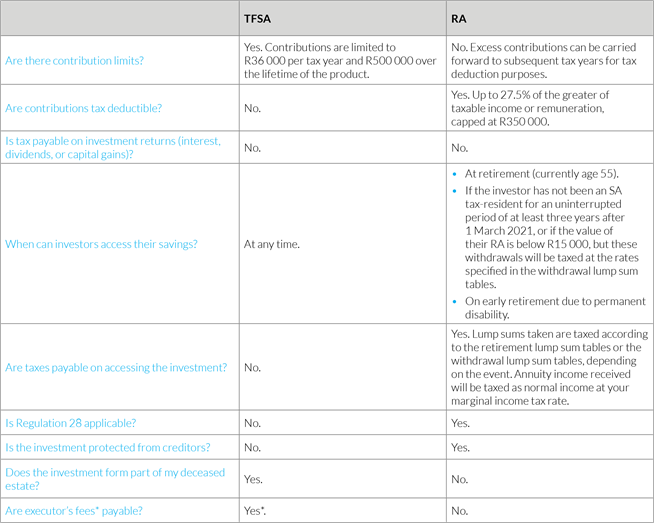
* Executor’s fees are not applicable to TFSAs issued by life insurance companies.
While both products provide tax incentives to save, as well as benefits when creating a long-term financial plan, appropriate product choices will depend on your individual circumstances.
A combination of the two may be the right approach to achieve the desired outcomes by leveraging the benefits of each to achieve your retirement and savings goals.
Choosing the right product for your needs
Since an RA is specifically designed to help you save for retirement, it should be your first choice in this regard. It allows you to contribute larger tax-efficient savings amounts, enabling you to build up a larger pot of retirement savings. Arguably, an RA is also more beneficial for retirement savings since (with some exceptions) you cannot access these savings until the age of 55, so temptation to withdraw retirement savings (and deplete your retirement capital) is removed.
Nevertheless, TFSAs are great products to supplement long-term savings, as they give you flexibility in two key areas outlined below.
- Access of your funds. Bear in mind however, that since TFSAs are intended for long-term investment, it is advisable to limit any withdrawals from these products, and instead let them grow over time to obtain the full benefit of the tax savings.
- Underlying investment choice. TFSAs are not subject to the limitations of Regulation 28, so you have greater flexibility on the assets in these portfolios.
With both products, there is one key element to keep in mind – start saving as early as possible.
Illustrating how tax-free investments can be used to supplement RA savings
A TFSA can make a valuable and flexible addition to your retirement income. The simplified example below considers an investor who saves in a TFSA to supplement the 15% of their salary they have contributed to an RA from the age of 25 years. They retire at age 65, transfer the untaxed lump sum portion of their RA to a living annuity and select a drawdown rate of 6%. (Drawdown rate is the annual income paid from a living annuity expressed as a percentage of the total portfolio value.)
At retirement, they have the option of using their TFSA savings as an additional source of tax-free retirement income. The additional monthly income they can add to their RA income from their TFSA is shown below.
Additional income generated at retirement by drawing on TFSA savings (in today’s money)
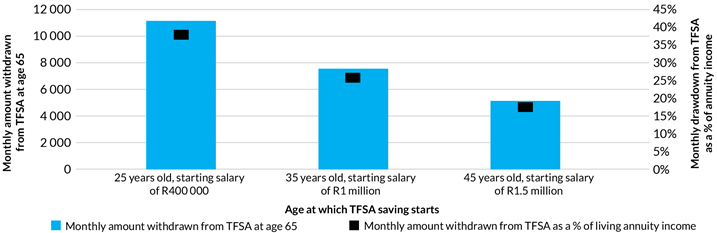
Assumptions: Duration of retirement period is 30 years, maximum amount allowed saved in the TFSA, no withdrawals from the TFSA before age 65.
A key item to remember with RA and TFSA contributions
With a TFSA, you will be penalised if you contribute more than the R36 000 annual allowance. A penalty of 40% will be applied on amounts exceeding this limit.
With an RA, there is no penalty for exceeding the tax-deductible contribution amount. There is an annual tax-deductible limit on RAs, but you may contribute more than 27.5% of your income. Any excess amount is carried over to the next tax year, and therefore has the potential to provide tax relief in future years.
Considerations regarding the underlying investments in each product
With a TFSA, the restrictions are less limiting than with an RA. TFSAs are not allowed to invest directly in securities or funds that have performance fees. However, you can invest in exchange traded funds and funds that have 100% offshore exposure.
By contrast, RAs are subject to various limits on exposure to the major asset classes, most notably a limit of 75% that can be invested in shares. In addition, only 45% of your RA can be invested offshore.
A note on investing in a TFSA on behalf of minors
A TFSA can be opened by any individual who has a tax number, or for a minor who has a South African ID number. This can be useful for parents who want to start saving for their children’s education.
Keep the following factors in mind when deciding on investing in a TFSA for your child:
- If you open a tax-free savings account in the name of a minor and exhaust their R500 000 lifetime contribution allowance (for example by the time they are 18 years of age) they will not be able to contribute further to a tax-free savings account.
- Once your child turns 18, the investment will vest in their name, and they will be allowed to withdraw the funds.
- The above needs to be weighed up against the benefit of opening a TFSA early and allowing it to achieve its maximum growth potential.
Conclusion
TFSAs are ideal investment vehicles to supplement retirement savings, as they allow for additional flexibility and diversification. However, finding the right balance between an RA and a TFSA may not always be a simple task. It is important that you engage with a financial adviser to support you through this process.

Stay Informed
Sign up for our newsletters and receive information on finance.
