Fraudulent Telegram and WhatsApp groups
Please beware of fraudulent Telegram and WhatsApp groups impersonating PSG Financial Services, our divisions and our advisers. Be cautious, verify links and contact your adviser or Client Services if you have any queries or concerns.
05
April 2023
Financial freedom and generational wealth
Mariska Comins, Head of Technical Support
PSG Wealth
Financial freedom is all about creating the best quality of life that you can for you and your family. Making the right choices today is a step in the right direction towards ensuring that your family’s financial future is secure.

“ Financial peace of mind is not determined by how much we make, but is dependent upon how much we spend. – Marvin J. Ashton ”
Peace of mind and financial freedom goes beyond just making the correct investment and savings decisions. It extends to preparing yourself and your family for unforeseen circumstances and circumstances that are not always top of mind. Death and disability, for example, are not events we can avoid – one is a certainty, and the other, a possibility.
According to the findings of ASISA’s 2022 Life and Disability Insurance Gap Study, 14.3 million income earners in South Africa only had sufficient life and disability insurance to cover 45% of the total needs of households. This statistic implies that households with one primary income earner would have to reduce their household expenses by more than half should that person pass away or become disabled.
Key considerations in achieving financial freedom
Your financial situation should be viewed holistically. This includes investments, life cover and short-term insurance. Creating a holistic plan of your financial goals and needs (and keeping that plan updated as your needs change over time) is crucial in creating peace of mind and, ultimately, financial freedom. Employer benefits like group life cover and retirement funds are often overlooked but are important to include to ensure you have a true reflection of your financial plan.
Having a good understanding of the resources available to you (like proper budgeting, debt reduction and estate planning) and making use of those that are applicable to your individual circumstances will give you a solid foundation towards achieving financial freedom and help you avoid a scenario of being caught on the back foot in the future. In the words of Marvin J. Ashton, "Financial peace of mind is not determined by how much we make but is dependent upon how much we spend."
Death cover
Talking about death is a tough conversation in most families, but it is inevitable. The first and most important step when it comes to planning for your death is creating a will. Make sure that those you leave behind and the person you trust carry out your final wishes (executor) are aware of your wishes. This will greatly assist in handling your estate as efficiently as possible, making sure your dependants have access to their inheritance, rather than them having to struggle (potentially for months) before they can access assets or funds from your estate.
Life policies are another helpful tool when planning for your passing. Apart from providing future income for your family, proper estate planning will reduce your estate duty liability and help provide your dependants with sufficient liquidity to cover debt and other related expenses, thereby ensuring that you don’t leave your family with an unexpected financial burden.
Disability cover and income protection
This is a form of cover designed to pay out in the event of you becoming temporarily or permanently unable to work due to an illness or injury, and is intended to replace (either in part or in full) any future earnings that you may lose in the unfortunate event that you are unable to perform your occupation. Income protection is a benefit that provides cover during temporary illness and does exactly what the name says – it pays out a percentage (usually maximum 75%) of your income for a period of time in which you are unable to work.
Dread disease cover (also known as critical illness or trauma cover)
Dread disease cover is aimed at providing cover for medical conditions that would have a major impact on your life. This includes illness or injury that would require costly treatment or rehabilitation and which has a medium to long-term recovery period, as well as conditions that would require significant lifestyle changes. When considering the appropriate level of dread disease cover for your specific needs, you should take into account factors such as your family’s history of chronic diseases, how comprehensive your medical aid is, whether or not you have gap cover in place, and the extent of your disability insurance.
Retirement and discretionary investments
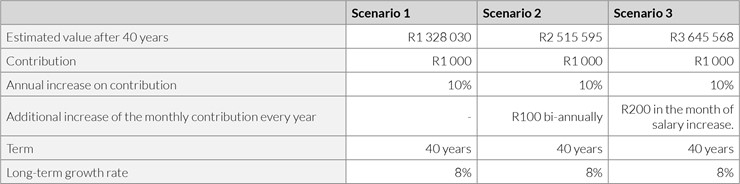
Retirement planning is immensely important in achieving financial freedom and neglecting this aspect of financial planning is a common cause of financial hardship amongst elderly people – especially in South Africa. Early on in my career, a very good friend of mine taught me to increase both my retirement- and discretionary investment contributions by R100 bi-annually over and above the annual contribution escalation. The reason for the low increase is that it has a low impact on monthly cash flow, but even a small increase can have a large impact over time. I am proud to say that I have stuck to this for the majority of my career.
Although there have been challenging times when I had to stop contributions, I agreed on a date with my financial adviser to restart contributions, and he kept me to it every time – as hard as it was. Financial freedom remains my key goal and in my retirement years I’m sure that I will reap the benefits of the sacrifices I have made during my working years.
The table below depicts three scenarios that demonstrate the impact that an additional small contribution of R200 can have over a 40-year investment term.
Conclusion
Always keep financial freedom as your key goal and ensure you don’t just provide for yourself and your family, but create independence during your retirement years, thereby giving your family the opportunity to build their own financial freedom.

Stay Informed
Sign up for our newsletters and receive information on finance.
