Fraudulent Telegram and WhatsApp groups
Please beware of fraudulent Telegram and WhatsApp groups impersonating PSG Financial Services, our divisions and our advisers. Be cautious, verify links and contact your adviser or Client Services if you have any queries or concerns.
28
November 2025
When constant demand erodes discipline: How investors forgot to price risk

Ané Craig, Fund Manager
PSG Asset Management

When constant demand erodes discipline: How investors forgot to price risk
South African investors have always had an affinity for yield. However, the recent dynamics in the local listed credit market suggest that enthusiasm has started to outpace rationality. Persistent and material imbalances between limited credit supply and sustained demand have created an environment where the fixed income market’s most critical function – pricing risk – has become increasingly distorted. This potentially exposes investors to a number of painful repricing scenarios, which could have material impacts for the outcomes investors ultimately achieve.
How did the mispricing problem arise?
This supply-demand imbalance is neither new nor surprising. For several years, fixed income analysts and portfolio managers have highlighted a structural shortage of listed credit. Weak gross domestic product (GDP) growth and chronically low business confidence have left corporate South Africa hesitant to issue term debt, with many companies preferring to maintain strong balance sheets and avoid longer-term commitments. At the same time, these economic conditions have nudged investors towards income funds rather than equities, as muted sentiment has reinforced a preference for lower-risk assets.
The result has been a substantial pool of capital competing for a limited number of high-quality credit opportunities.
| Quick credit 101 Bond prices move inversely to yield: a higher yield implies a lower price, and vice versa. Most of the South African credit market is priced on a floating rate basis. The credit spread (which compensates investors for credit and term risk) is quoted over a floating benchmark rate, currently the Johannesburg Interbank Average Rate (Jibar). The higher the credit spread, the riskier the bond is perceived to be, and the more investors are compensated for lending to that issuer. |
When everyone is chasing the same bond
In such an environment, it is easy to focus on the ‘best’ available yield – the highest spread or apparent return – without asking the most fundamental question: Am I being adequately compensated for the risk I am taking?
However, when supply is constrained and demand is excessive, it is easy for the discipline underpinning risk-based pricing to weaken. Investors begin to lose perspective on what constitutes fair compensation for the underlying risks, and the market becomes increasingly vulnerable to mispricing in both directions.
When ‘high risk’ isn’t: The mispricing of Transnet government guaranteed bonds
In August this year, Transnet raised R15 billion via a private placement. Although the arrangers initially aimed for R10 billion, they were met with demand far exceeding the target. The seven-year bonds were ultimately priced at a spread of 230 basis points (bps) over Jibar, meaning investors required an excess return of 2.3% over the (almost) risk-free Jibar benchmark rate.
This is puzzling, given that the bond is fully guaranteed by National Treasury and therefore carries exactly the same credit risk as a government bond. At the time, a seven-year bond issued directly by National Treasury was trading at only 94bps over Jibar.
Why, then, a premium of 136bps? What additional risk did investors believe they were being compensated for? While it is true that the government guaranteed Transnet bond may not be quite as liquid as a bond issued directly by National Treasury, a premium of 1.36% appears excessive.
Then a more rational outcome emerges
Three months later, on 6 November 2025, Transnet returned to the market – this time through a public auction open to all investors. The response was extraordinary: total bids reached R41.77 billion for an issue size of only R5 billion, an oversubscription ratio of more than eight to one.
Unsurprisingly, spreads compressed significantly. To compare the change in pricing to the August placement of Jibar +230bps, we look at the interpolated spread for seven-year paper. This narrowed by 69bps, to Jibar +161bps. While this pricing appears more reasonable, it still represents roughly 0.7% of additional yield over government bonds with the same underlying risk profile. And again, with such depth of demand, it is difficult to argue that investors were taking on meaningful liquidity risk.
Compared to the August pricing, it appeared (briefly) that the market had become somewhat more rational. However, a Development Bank of Southern Africa (DBSA) placement only two weeks later told a different story. The DBSA, which has substantial exposure to municipalities of varying financial strength and carries no guarantee from National Treasury, was able to borrow money at a rate that was only 0.14% more expensive than Transnet’s government guaranteed issuance.
Part of the problem is that many bonds are issued privately. Private placements limit broad market participation, which inhibits effective risk-based price discovery. But even allowing for these nuances, the pricing behaviour of professional investors is increasingly difficult to justify.
Mispricing in practice
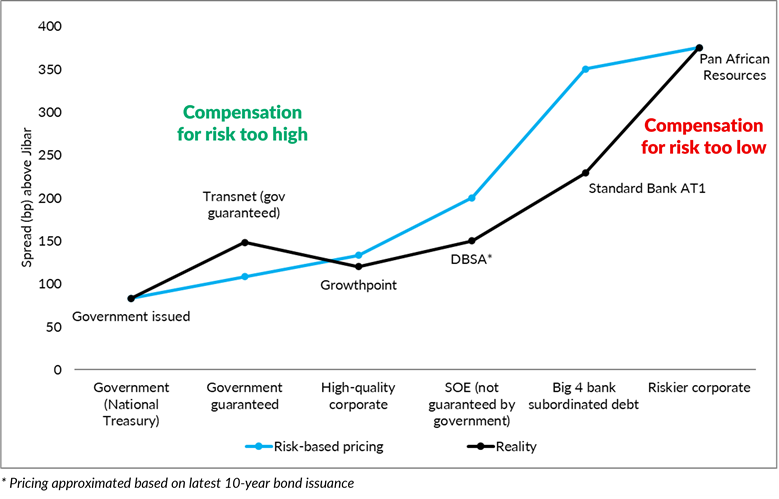
Consider the graph below. The blue line represents roughly where risk should price based on fundamental credit risk (PSG Asset Management’s estimate of fair value). The black line shows where the market is actually pricing risk today.
When the black line sits below the blue line, the credit market is expensive and investors are receiving limited compensation for taking on credit risk. When the black line sits above the blue line – as with the Transnet bond – investors are being compensated unusually well for the level of risk involved.
Pricing in the SA listed credit market (5-year bonds)
Sources: PSG Asset Management
One of the most striking mispricings in the chart above is the Standard Bank AT1 note. It is worth emphasising that this is not a Standard Bank issue specifically – all major banks are now able to issue AT1 instruments at similar levels. The concern is the nature of AT1 instruments themselves. In a stress scenario, these notes can be written down or converted into equity at the discretion of the Prudential Authority, as Credit Suisse investors discovered in 2023 when their holdings were wiped out.
Yet South African AT1 spreads are now trading in line with the government guaranteed Transnet spread of August 2025, and far from where fundamental risk-based pricing suggests these high-risk instruments should sit.
When instruments with such disparate risk profiles trade at similar spreads, it is a clear sign that the market is no longer effectively differentiating between levels of credit risk.
Why this matters
Do divergences between pricing and fundamentals matter, if investors are earning a reasonable yield?
We believe it does. Credit markets can reprice assets, leading to wider spreads and capital losses in these instruments. In addition, credit issuers do sometimes default: African Bank, Steinhoff, the Land and Agricultural Bank of Southern Africa, SA Taxi/Bridge Taxi… and none of these entities were considered ‘risky’ when they issued bonds. Notably, PSG Asset Management’s income funds had no exposure to any of these instruments at the time of default.
Pricing risk correctly is the key consideration for income investors. At PSG Asset Management, we believe that protecting capital by avoiding permanent losses should always take precedence over chasing incrementally higher yields. Our focus is on sustained outperformance. Over the long term, our income and multi-asset income funds have consistently delivered returns above cash and inflation. But this outperformance has been achieved without compromising on sound risk management.
Ané Craig is the Head of Fixed Income at PSG Asset Management.
Recommended news

Welcome to the latest edition of the Angles & Perspectives - Q3 2025
In this edition, we consider what lies ahead after a strong run in equity markets and given rising levels of market concentration. Head of Research Kevin Cousins highlights the hidden risks in hugging an index. Fund Managers Shaun le Roux and Mikhail Motala unpack the drivers behind the equity rally, and share where they are currently finding opportunities locally. Finally, Fund Manager Philipp Wӧrz and Deputy Chief Investment Officer Greg Hopkins turn their focus to global markets, and explain the value of our differentiated approach.
Read moreThe hidden risks of hugging an index - Angles & Perspectives Q3 2025
Read moreAn integrated approach offers advantages – no matter where you’re investing
Read more
Stay Informed
Sign up for our newsletters and receive information on finance.
