Fraudulent Telegram and WhatsApp groups
Please beware of fraudulent Telegram and WhatsApp groups impersonating PSG Financial Services, our divisions and our advisers. Be cautious, verify links and contact your adviser or Client Services if you have any queries or concerns.
25
February 2026
Global investing: Have you considered some of the ‘what ifs’?

Philipp Wörz, Fund Manager
PSG Asset Management

Global investing: Have you considered some of the ‘what ifs’?
Until the end of 2024, US equity performance had outstripped that of the rest of the world for 12 of the previous 15 years. Markets are prone to extrapolating based on past events, and this experience, coupled with the fact that the US is home to the largest and some of the most innovative companies globally, unsurprisingly resulted in investors being ‘all in’ on US markets at the beginning of last year.
By now, it is well known that markets outside the US and select emerging markets in particular were the standout performers across global equity markets in 2025.
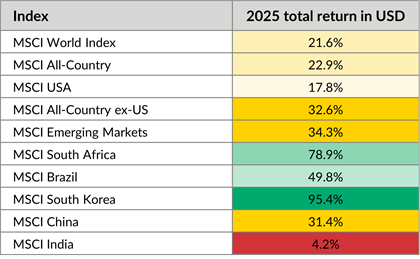
Source: Bloomberg
Cheaper starting valuations positioned rest-of-the-world (‘ex-US’) equities to outperform the US last year, with the weaker US dollar accelerating this trend.
We have argued for some time that we entered a new investment regime following the Covid-19 pandemic (driven by the end of zero interest rates, higher fiscal spending across developed markets (DMs) and geopolitical fragmentation), and have been finding more attractive opportunities in markets outside the United States. This has resulted in our portfolios being positioned to capitalise on ex-US outperformance.
A central question on investors’ minds is whether last year’s performance differential is an outlier or potentially the beginning of a longer cycle of ex-US and emerging market outperformance.
In this article, we aim to add some colour to this pertinent question and assess some potential implications for investors’ portfolios.
What if markets outside the US continue to outperform?
Despite a shifting narrative, most global investors’ portfolios are not positioned for ex-US outperformance, given that the vast majority of global equity market capitalisation is invested in US assets. This is reflected in the MSCI World Index’s 71% and MSCI All Country Index’s 63% weighting to US assets at the end of January this year, and is confirmed by a glance across most large global equity mutual funds’ fact sheets.
Furthermore, the United States’ net equity investment position (the value of foreign stocks owned by Americans minus the value of US stocks owned by foreigners) has swung from a significant asset to a large liability over the past 20 years. This means foreign investors own substantially more in US stocks than US investors own rest-of-the-world (ex-US) stocks.
Efforts by rest-of-the-world investors to reduce their US exposure (such as Danish pension funds selling out in retaliation to threats on their sovereignty) can therefore have large implications for asset prices.
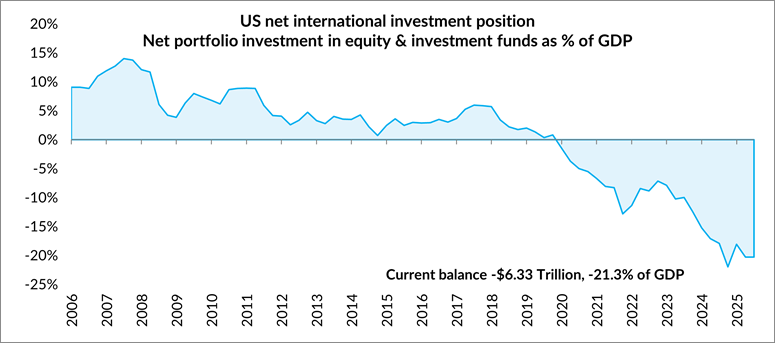 Source: Bureau of Economic Analysis
What if the winning sectors of the past, such as tech stocks, are not the winners of the future?
Information technology and related sectors have been the standout winners over the past 15 years, with the onset of artificial intelligence (AI) being a significant accelerant to this outperformance over the last two years. From December 2010 to December 2025, the MSCI World Information Technology Index returned 18.7% per annum compared to the MSCI World Index’s total annual return of 11.2% per annum in US dollars. While it appears that AI is here to stay and is set to evolve quickly, vast sums of capital are being invested into areas where future returns are uncertain. This contrasts sharply with several older economy industries and sectors that have been starved of capital over the past decade, and where the risk of AI disintermediation appears lower. This lays the foundation for improved pricing power and potential future returns, especially given attractive starting valuations.
While the technology and related sectors account for a large percentage of global and US markets (MSCI IT weight 26% in MSCI World, while stocks such as Alphabet (4.3%) and Meta (1.8%) are classified in communication services and Amazon (2.7%) in consumer discretionary), sectors such as materials and energy account for respectively 3.5% and 3.7% of the MSCI World Index. Small changes in sector allocations away from potentially overvalued and ‘over-owned’ sectors can have an outsized impact on future returns.
A recent potential parallel of this was the period post the dotcom bubble in the early 2000s. While the market overall declined significantly from March 2000 (with the Nasdaq Index declining by nearly 80% in the process), sectors such as consumer staples and energy outperformed materially, and ended up delivering strong returns for the five years post the peak of the market.
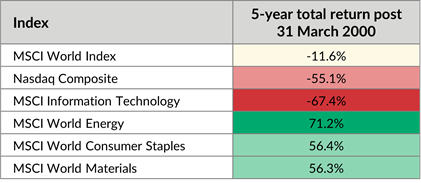
Source: Bloomberg
What if the recent emerging market outperformance continues?
History suggests that emerging market cycles last longer than one year. The chart below shows the performance of emerging markets relative to US stocks. Emerging markets (EMs) experienced huge underperformance in the late 1990s (Asian crisis in 1997, Long-term Capital Management (LTCM) collapse in 1998), before entering a multi-year cycle of outperformance until the Global Financial Crisis in 2008. The past 15 years have seen significant US dollar strength and emerging market underperformance, resulting in many emerging markets being deemed uninvestable or irrelevant to large pools of global capital. Given relatively favourable starting valuations (in most EMs), fiscal and political outlooks, we are identifying attractive opportunities across several emerging markets. Should outperformance continue, we would expect more global capital to flow into these markets, which would be favourable to South African investors.
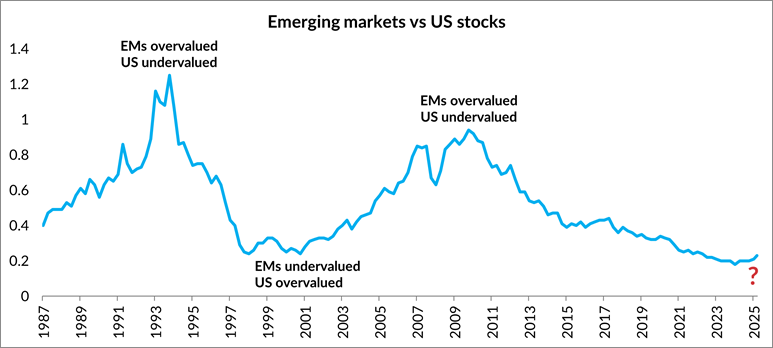
Sources: Bloomberg, PSG AM; calculation: MSCI Emerging Markets Index / S&P 500 Index
What if the above is wrong and US markets regain their lead?
PSG Asset Management is a bottom-up, macro-aware investor. We attempt to construct robust portfolios that cater to a multitude of outcomes and identify opportunities where the market is underappreciating inherent qualities. This enables us to invest with a margin of safety. Given relatively extended starting valuations for stocks dominating global and US indices, we are comfortable with reduced US exposure, as we expect relatively pedestrian return prospects from this area.
Our global funds are currently skewed towards global value (mainly ex-US) assets, secular winners in emerging markets and real asset companies (such as miners and energy stocks), but our proven 3M investment process leads us to find attractively priced opportunities across diverse sectors and geographies, including in the US market. Importantly, this process also equips us to construct portfolios that are able to do well in a variety of circumstances. Despite a volatile and risky environment, we believe active, bottom-up managers like PSG Asset Management are well positioned to construct lower-risk portfolios that should outperform over the medium to long term.
Philipp Wörz is a Fund Manager at PSG Asset Management.
Recommended news

Boom or bust in 2026? That is the wrong macro question! - Angles & Perspectives Q4 2025
Read moreWelcome to the latest edition of the Angles & Perspectives - Q4 2025
In this edition, we discuss how our process leads us to construct portfolios that are able to do well in a variety of market conditions. Head of Research Kevin Cousins discusses the shortcomings of forecasts, and our preference when navigating an uncertain macro environment. Chief Investment Officer John Gilchrist shares how our stock selection positions our portfolios to excel in a variety of scenarios, while Fund Manager Marc Beckenstrater asks whether large, global managers are really best positioned to deliver performance to investors. Finally, Fund Manager Duayne le Roux highlights that despite a softening interest rate environment, inflation-linked bonds can make an attractive addition to fixed income portfolios.
Read more
What we know for sure about 2026
Read more
How will 2025 be remembered?
Read more
Stay Informed
Sign up for our newsletters and receive information on finance.
